

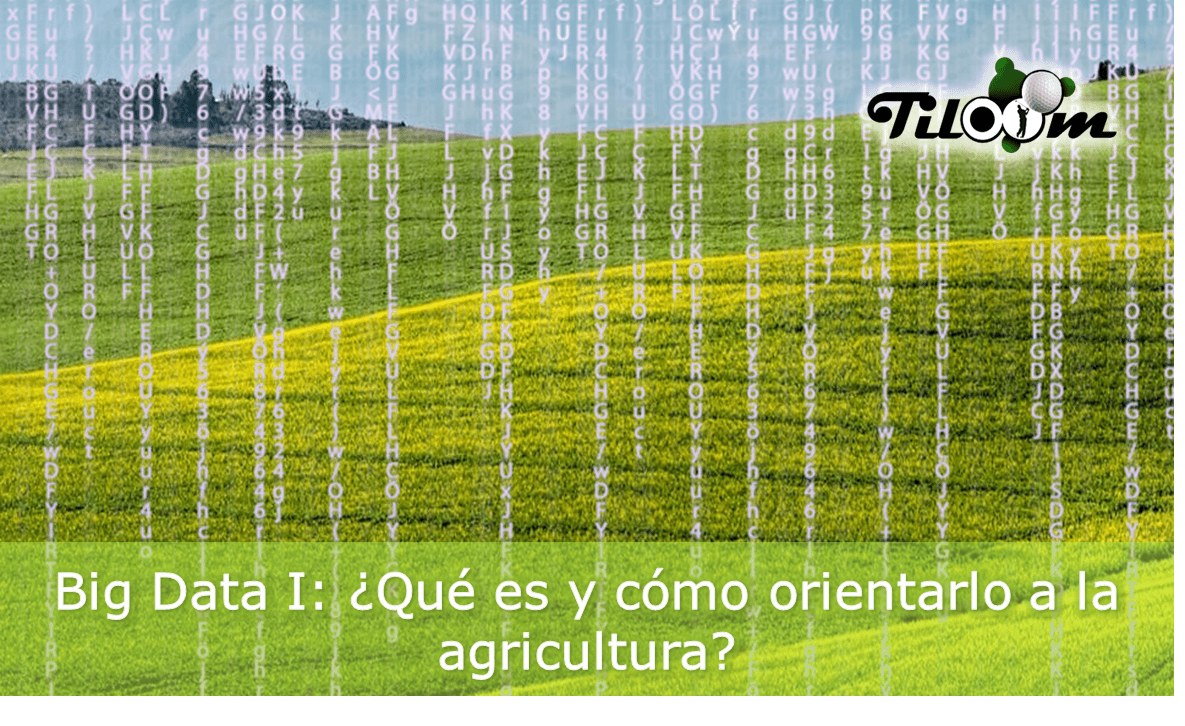
It seems that nowadays you can't take two steps without hearing of the Big Databoth for the management of sports surfaces as well as in agriculture. In this article we will explain what it is, as well as give you a brief description of its use.
The collection of information is what is considered to be Big Data. This includes, for example, all the data provided by a weather stationThe information that can be obtained from irrigation water or soil with continuous or discrete monitoring sensors and even any input information during cultivation.

All this accumulated and unstructured information is a problem to be solved. Thanks to data management software and the processing power of computers, this raw data is converted into information of great added value.
Once the information is sorted and structured, a new world of possibilities opens up. Relationships between parameters can be established. For example, in sports turf it is possible to relate the hardness of a pitch to the hardness of the turf. football (gravities), measured with the Clegg hammer, with the levels of soil moisture (%VWC), measured with humidity sensors.

As in the previous example, many other values can be related. Finding the perfect time of day to irrigate; knowing the factors that modify the watering time; finding the right time of day to irrigate; knowing the factors that modify the watering time. pH; the electroconductivity from irrigation water or soil; to provide for the formation of "black layer"in soil profiles (low infiltration rates in soils with high percentages of volumetric moisture contents irrigated with sulphate water), etc.
Harnessing the data generated is the most powerful knowledge tool that agriculture has ever encountered. The organisation of this information is optimising the use of resources. The use of inputs will never again be based solely on experience and intuition; information is here to stay.
Tiloom develops and offers a complete range of monitoring and control in agriculture and sports turf. We can offer you powerful tools for pumping control, continuous and discrete variable monitoring with coaxial impedance sensors like POGO o TDR's.
Make better decisions with us, our top quality services and our more than 15 years of experience in Football and Golf are our guarantee:
 Español Español
  English (UK)
 Português
 Français
 Italiano
 Deutsch
 العربية


One Response
You indiscriminately use the term data and information.
The difference between data and information lies in the frame of reference that the data has to "pass" to generate information. For example, the data that indicates that a ground is at 120 mB of voltage provides absolutely nothing unless we have a frame of reference that tells us in which voltage ranges that ground has to be.