

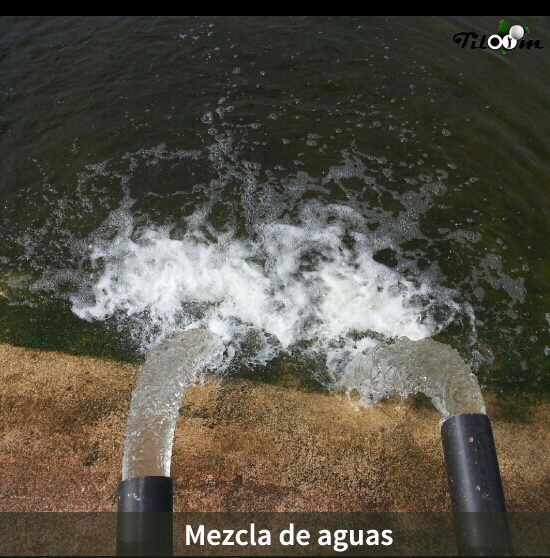
The waters of irrigation The quality of the water available to us can vary greatly, as can the needs of the different species we may have on our golf courses or other sports facilities. That is to say, we may require better water for Agrostis greens and worse for Bermuda fairways, or that due to reseeding on golf courses, we may require more water for the different species. football The need for quality varies seasonally, with better quality required for ryegrass reseeding in autumn and poorer quality when transitioning to Bermuda in the spring-summer season. It is therefore important to know the most optimal way to reseed. water mixtures.
Parameter Salinity in irrigation water (dS/m)
------ 0 -- 2 -- 4 -- 8 -- 12 -- 16 - 20 - 24
% Germination 96.5 95.5 95.5 92.5 88.0 78.0 67.0 67.0 53.0 20.0
Days to germination 6.21 6.14 6.56 7.68 8.82 10.79 10.61 11.71
Germination of Rye grass according to salinity in irrigation water, Iiker Nizam, 2011.
Irrigation water mixtures have to take into account two aspects, such as the salt content and chemical speciation, since the salt content will have an influence on the tolerance that the different varieties may present and the chemical speciation on the possible formation of lime scale in the irrigation facilities or different pH values that the irrigation water may reach. For this purpose, water engineering software can be used to optimise the mixture as desired.

The salt content of the water mixture is the average result of the weights of each water and the percentage of each one, so if we mix two types of water A y B in a 30% and 70% respectively the result is easy to calculate:
A. 2ppm
B. 0.5ppm
[0.3 x a (ppm water A) + 0.7 x b (ppm water B)]/2= [(0.3 x 2) + (0.7 x b)]/2= 0.6 + 0.35= [(0.3 x 2) + (0.7 x b)]/2= 0.6 + 0.35= [(0.6 x 0.35) 0.95 ppm shall be the concentration of the mixing water.
The use of the Pogo will also give the instantaneous measurement, simply by dipping the rods into the mixed solution.
The calculation of chemical speciation, however, is somewhat more complicated and requires the water modellingThe new water, with which we can predict the behaviour of the new water, both of its pHthe possibility of calcareous incrustations, redox potentialand much more...

With Rigometer you can now monitor all the water quality parameters you can imagine. It is a customised system developed by Tiloom with which you can know all the variables that affect your pumping system.
Do you know it?
 Español Español
  English (UK)
 Português
 Français
 Italiano
 Deutsch
 العربية





One Response
Hello,
If we mix two irrigation waters, with two different pH, what will be the resulting pH? If we know the pH of each water and the % of the mixture, can we calculate the resulting pH with the law of mixtures? Thank you very much