
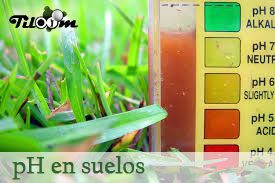
pH and alkalinity of soils are two very important parameters of the soil to know the soil quality.
The pH of a solution is defined as the minus logarithm in base 10 of the hydrogen ion activity.
Neutrality will be given by pH equal to 7, acidity will be the range from 0 to 7 and alkalinity from 7 to 14.
The H+ concentration will be multiplied or divided by 10 each time the pH decreases or increases by one unit, hence if the pH decreases by 2 units, the H⁺ concentration will increase by 100 times and vice versa.
But what causes these concentrations to increase or decrease in the soil? Well, it is not only the supply of acids or bases alone, but many processes that are interconnected with the soil reaction. Soils react acidic or basic by their reaction with the moisture present, i.e. according to their pore water, and this will be influenced by different factors such as the nature of the irrigation water, fertilisers used (depending on whether they react acidic or basic), microbial activity (edaphic respiration), decomposition of organic matter which produces CO2 (which in turn is transformed to carbonic acid), nutrient retention capacity, limestone content, etc...
Thus we can express the pH as a function of the carbon cycle according to the elements and compounds of which the substrate is composed, as can be seen in the image.

Between pH values of 6.3 and 10.3 the concentration of bicarbonate is the most predominant form. Thus calcareous soils (right side of graph) will tend to be basic and those with organic matter and high rates of organic matter decomposition (left side of graph) will tend to be acidic.
The pH is one of the most important factors deciding the fertility and viability of certain soils, it will influence the nutrient availability and whether they can be solubilised and taken up by the roots.
Thus, each nutrient will be available to the plant in a particular pH band, as can be seen in the graph.

Illnesses such as Spring Dead Spot (SDS) on Cynodon dactilon (hybrid bermudagrass), and Take all Patch o Microdochium Nivale in Agrostis (the species that accounts for 95% of our Spanish golf courses) are favoured by alkaline pH, therefore maintaining soils with slightly acidic pH is a good management strategy.
More information can be found at the source: Smile, Richard et al. Compendium of Turfgrass Disease, 1983.
There are a number of different pH sensors on the market, of the portable type. Tiloom has tested the Fieldscout Soilstick meter, which we can offer you if you need it.

 Español Español
  English (UK)
 Português
 Français
 Italiano
 Deutsch
 العربية