

The temperature is another of the most influential factors in the growth and development of sports surfaces. The greens of C3 species such as Agrostis have the ideal intervals for leaf growth between 18 and 24°C, but root growth is optimal between 10 and 18°C (Beard, 1973). It is also possible to estimate the expected growth according to monthly mean temperatures, by means of the so called Growth Potential (Growth Potential), introduced by Stowell. L, (Pace Turf).
C3 species such as Agrostis stolonifera, with average temperature requirements of around 19.5ºC in temperate zones, or C4 species such as Cynodon Dactylon, with average temperature requirements of around 30.5ºC in tropical zones, will be used.
Both the water absorption as of nutrients is achieved by the moisture gradient from the roots to the stomata of the leaves, a process driven by evapotranspiration, which is temperature-dependent.
The microbiological development is also temperature-dependent, with some organisms (fungal diseases, bacterial infections, etc.) proliferating according to temperature.
Other abiotic processesSummer Bentgrass Decline, such as summer stress due to high temperatures, causes root loss and death, deficiency in the photosynthesis process and low physiological activity, which occurs in Agrostis greens due to high temperatures. volumetric moisture contents (VWC) that displace oxygen and by the presence of high daytime (>35ºC) and nighttime (>25ºC) temperatures, Huang. B et al.
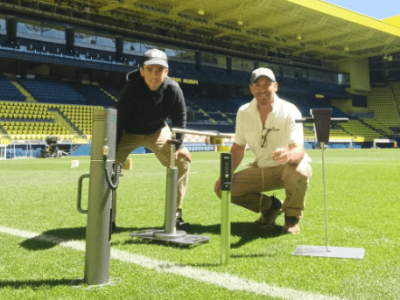
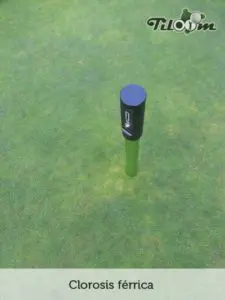
The POGO tool, with its humidity, temperature and conductivity probes, offers an extraordinary capacity to anticipate these phenomena that are so harmful to our greens.

 Español Español
  English (UK)
 Português
 Français
 Italiano
 Deutsch
 العربية