

This report, drawn up by TILOOM, follows the guidelines of the Spanish Croquet Federation, setting out the technical standards for the construction and maintenance of playing fields. The guide details fundamental aspects such as the dimensions and marking of the pitch, and defines playability criteria based on speed (measured using a Plummer or Lambertometer), firmness (Clegg hammer) and levelling. It also covers turf maintenance, perimeter management and equipment requirements for achieving the various levels of official certification.
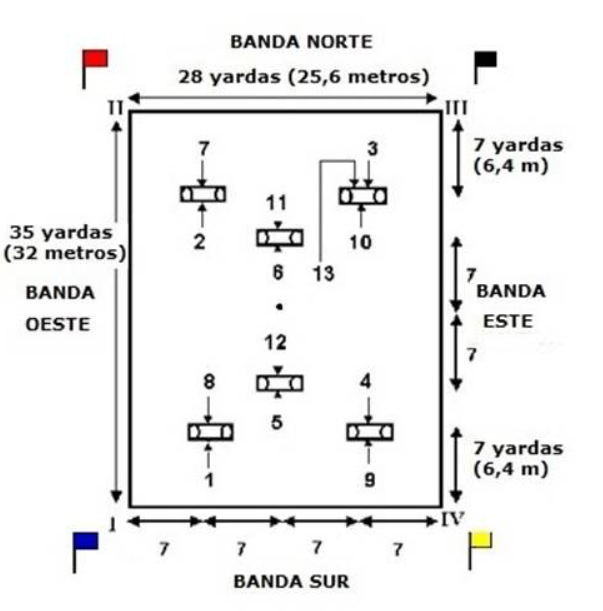
The dimensions of the pitch are 32 metres long (35 yards) and 25.60 metres wide (28 yards).
Smaller size fields (not suitable for official national or international competitions) are possible, as long as the ratio 5 to 4 between length and width is maintained. These fields may be valid for the minor or social (non-international) variants of croquet (garden croquet, short croquet, ancient croquet, extreme croquet, two-ball croquet, including nine-wicket croquet or six-wicket croquet).
No field shall be less than 22 x 17.50 metres (24 x 19 yards).
The length and width of the playing field each allow a tolerance of +/- 15 cm.
Two different devices or methodologies are used to calculate the speed on a Croquet field: Lambertometer and the Plummer.
Plummer
It is calculated based on the time it takes the ball to travel a given distance. This is the time (in seconds) it takes the ball to travel 35 yards (~32 m) with a standard slope.
Lambertometer
It consists of a 1.2 M long ramp with an elevation of 30 cm, this segment should generate an angle of 30° to the horizontal along which a croquet ball runs. The distance the ball travels provides a measure of turf speed.
| 8 s - 9 s | Slow |
| 10 s - 11 s | Standard |
| 12 s - 13 s | Optimo |
| > 13 s | Extremely fast |
Reference values
The course must be firm enough so that the trajectory and energy of the strike on the ball is not affected.
A firm surface ensures that the ball rolls stably.
A firm surface ensures that the ball rolls stably. This parameter is measured with the Clegg Impact Hammer (Clegg Hammer), The tool is still the official reference in the technical manuals.
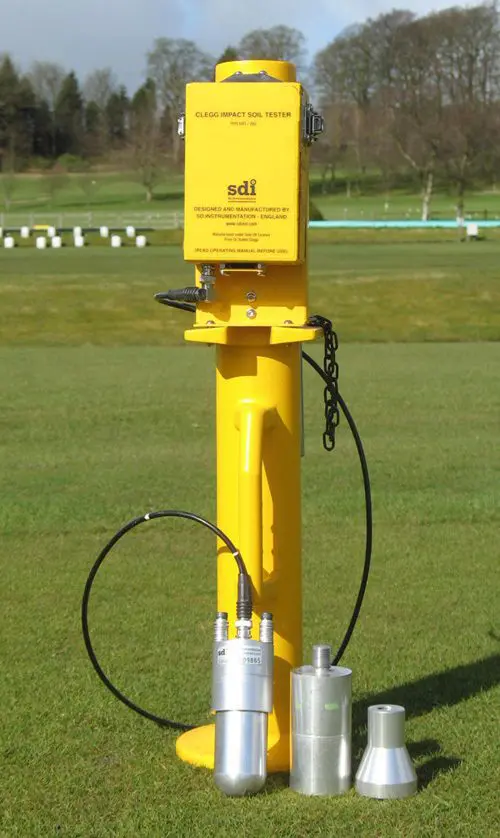
In the case of teams that manage golf courses and also own croquet pitches, a practical tool for the measurement of these parameters is the TruFirm. Although the values are not interchangeable, we can define an optimum value, < 6.35 mm penetration.
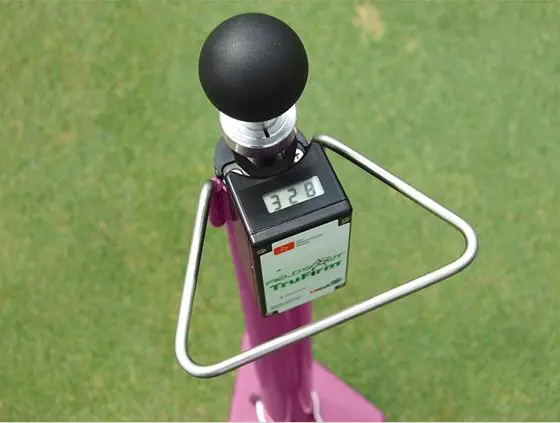
| State of the Field | Clegg Hammer (G) | TruFirm (Penetration in mm) | TruFirm (Penetration in inches) |
| Very firm | 85 - 100 | < 6.35 mm | < 0.25 |
| Standard | 70 - 85 | 8.9 - 9.7 mm | 0.35 - 0.38 |
| Soft | < 70 | 9.7 - 11.5 mm | 0.38 - 0.45 |
Reference Values - Trufirm Legend (Brian Whitlark, Agronomist USGA Green Section)
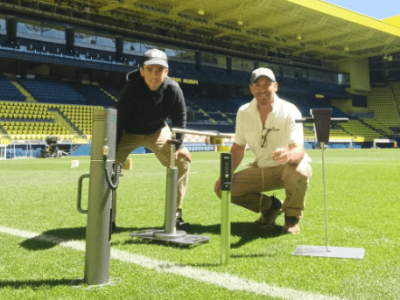
To measure these values it is recommended to use a uniformity tester. The evenness tester has been developed to measure the evenness of the surface. This test allows the uniformity of the field and its flatness with its different 3 and 4 metre versions.
The uniformity values taken as reference are: Normal < 1mm and Basic < 1.25 mm.
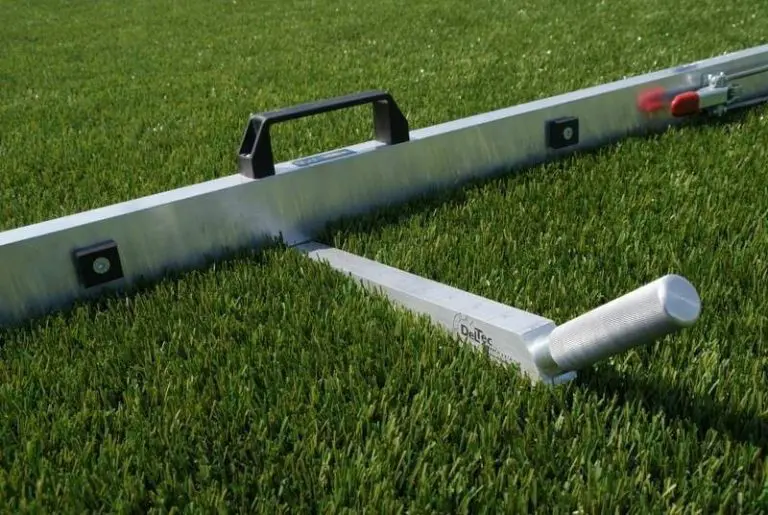
Reference values were taken from the standard UNE 147304:2020 “NATURAL GRASS SPORTS SURFACES. CONSTRUCTION SYSTEMS FOR GOLF SPORTS SURFACES, SPECIFICATIONS AND TEST METHODS”.
Corners are turning and tactical positioning areas where traffic is concentrated in very small areas. To keep the surface in optimum condition, more frequent manual aeration (spiking) should be carried out in the last 2 metres of the field than in the rest, to prevent the soil from becoming compacted and the grass from dying from root asphyxia. Using a liquid aerator is another valid option to improve these areas.
From Tiloom we offer a synergistic combination for a revolutionary solution: the combined use of EVR y Oxyturf + Kelp. EVR is a bio-adjuvant and moisturising agent that optimises hydration. Oxyturf + KelpThe soil oxygenates the soil and provides the benefits of kelp (Ecklonia maxima). Together, these products create an ideal environment for a healthy and resilient lawn. Finally it is worth mentioning that for an even more categorical effect and to take your lawn to the next level, we recommend that you pre-stripe the turf with Ninja Tines.
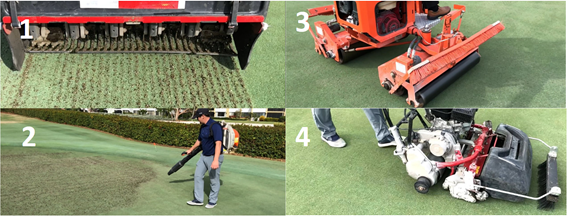
Over time, the top-dressing (top-dressing) tends to accumulate less in the corners or to create small “steps” against the edge of the field. Be aware of the levelling gradient. If the margin is higher or lower than the centre, the ball will be deflected when trying to play close to the sideline.
The length of the turf on a croquet lawn directly affects its speed. The normal cutting height for a flat croquet field is 4 to 5 mm during the peak season and 8 to 10 mm during the winter months. 4 mm is only recommended if cultivars that can be cut at this height are used. If the turf is undulating, it may be necessary to increase the cutting height to reduce the speed.
| 4-5 mm | Very low, faster and more predictable rolling |
| 6-8 mm | Medium, more friction |
| >9 mm | High, slow rolling |
Reference values
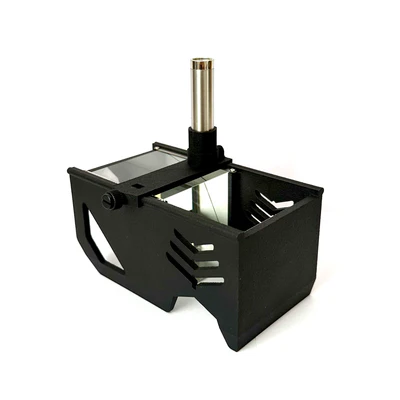
Laser lawn mowing height gauge for professionals This Turf HOC laser cutting height gauge is an essential tool for any turf professional seeking precision, efficiency and quality in the maintenance of green spaces and grass pitches
To achieve excellence in croquet, it is extremely important to maintain a surface that combines optimum rolling speed, accurate levelling and even firmness throughout the course.
Beyond the aforementioned standards and tools, the determining factor for success is the consultation and supervision of specialised technical personnel. managing a high-performance pitch requires in-depth knowledge of agronomy and soil mechanics; therefore, we recommend working together with sports turf experts to interpret data, adjust maintenance schedules and ensure that the investment translates into a premium playing surface.
Tiloom Technological Solutions S.L. offers a comprehensive consultancy and technical management service for the development of high performance croquet surfaces.
If you have any questions, we are here to help you. You can write to comercialgolf@tiloom.com or soporte@tiloom.com
A standard field measures 32 x 25.6 metres (35 x 28 yards). A tolerance of +/- 15 cm in length and width is allowed.
For social or smaller variants, a ratio of 5:4 length to width must always be respected. The minimum size allowed is 22 x 17.5 metres.
The Plummer method (time in seconds) or the Lambertometer (distance in metres) is used, the optimum speed for championships is 12 seconds,
The official benchmark is the Clegg Hammer, which should score between 85 and 110 Gm. The TruFirm can also be used, with an optimum range of 5-6 mm penetration.
In high season it is kept between 4 and 5 mm for higher speed.
The ideal is a completely flat surface (0%), especially in high competition, but a maximum slope of 0.5% is acceptable to facilitate drainage.
More frequent manual aeration (spiking) is recommended in the last 2 metres of the field. For a superior solution, Tiloom proposes the combined use of Oxyturf + Kelp to oxygenate the soil and EVR to optimise hydration, enhancing the effect with a prior micro-needling using Ninja Tines.
 Español Español
  English (UK)
 Português
 Français
 Italiano
 Deutsch
 العربية



2 responses
Is it possible to lay an artificial turf pitch?
If so, what is the recommended thickness?
The space I have isn’t suitable for natural grass at all, and it will be very difficult to maintain.
Where possible, a height of 11 mm to 13 mm is recommended for high-density textured fibre.
I’m sharing two links so you can find out more about croquet pitches with artificial grass; you might find them of interest.
http://www.oxfordcroquet.com/care/astro/