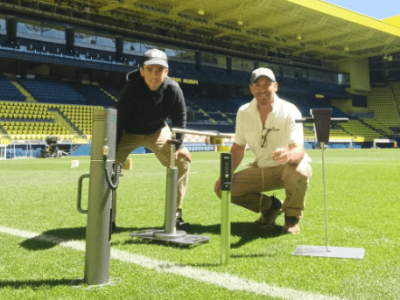

The infiltration rate of water into the soil is sports surfaces is a fundamental parameter to ensure the physical properties of the substrates. For its determination, the double ring infiltrometer.
Poor aggregate selection, soil compaction, excessive soil accumulation, excessive organic matterare common situations in which underperformance of the infiltration testBut there are other possible causes derived from the different iron speciations.
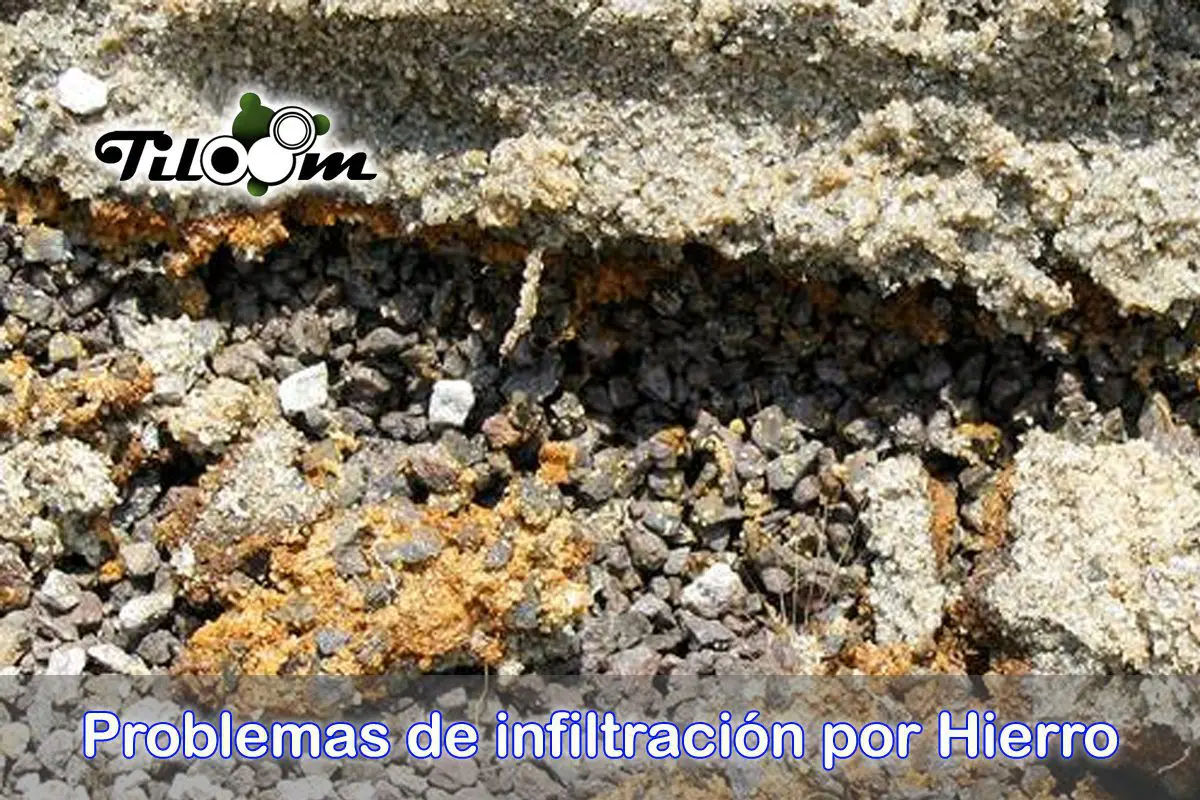
The iron is provided through fertilisation or as a consequence of the mineralisation of organic matter, mainly as Fe(II). These forms can produce in sandy profiles typical of greens, sports fields or agricultural crops on highly permeable acidic soils, the leaching of excess iron not assimilated by the roots towards the deeper layers, reaching the drainage systems, which if they are also alkaline and aerobic in nature, produce the oxidation of this Fe (II) and its precipitation as Iron Oxides (III), causing a layer or horizon on the boundary between the sandy layer and the draining layer of gravel. This phenomenon is even more significant the more acidic the sand and the more basic the draining gravel.

The greater the difference between the pH of the substrate sand and the pH of the substrate, the greater the difference between the pH of the substrate sand and the pH of the substrate. pH The thicker the gravel layer, the thicker the iron oxide layer will form in that horizon and the worse the infiltration will be due to the formation of the sealing layer.
The Soil pH controls the movement of Iron in the medium term, although the conditions of the redox potential in the soil do so in the long term, the ferrous forms (Fe +2) predominate in anaerobic environments and the ferric forms (Fe +3) in aerobic conditions.
It is therefore interesting to take this aspect into account when selecting the nature of the gravel, with those with an acid reaction being less likely to produce these problems in the future. Tests relating to these phenomena are being studied by Glen Obear and Bill Kreuser, University of Nebraska, Lincoln, using purpose-built devices. https://www.youtube.com/watch?v=iJzYzuITz44
If you wish to assess infiltration problems in your field, do not hesitate to contact us and we will offer you the best solution for each specific problem.
 Español Español
  English (UK)
 Português
 Français
 Italiano
 Deutsch
 العربية