

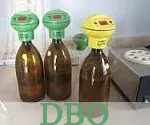
The DBO Biochemical oxygen demand is very important for the treated water. It represents the amount of oxygen required (mg/l) for aerobic microorganisms to metabolically oxidise the organic matter present in the water sample to carbon dioxide and water.
This biological oxidation or aerobic digestion is carried out in the cell by enzyme-catalysed reactions, and essentially consists of the combination of oxygen with the various organic materials, producing energy. Some of this energy is converted into heat and some is used by the cell for respiration and to generate new cells.
The rate at which micro-organisms consume the organic matter dissolved in the water depends on the composition and structure of the organic matter, as well as its concentration and water temperature.
The biochemical oxidation It is a slow process, the duration of which is, in theory, infinite. Therefore, as the BOD As this is a parameter strongly influenced by time, it is usually measured at two different times. Thus, there are:
BOD5oxygen quantity (mg/l) consumed in the degradation of organic matter by biological means, after incubation of the water for 5 days at 20°C and in the dark. The BOD5 gives an idea of the biodegradable organic carbon in the sample. Under these time and temperature conditions, approximately 2/3 of the total biodegradable organic carbon in a wastewater is biograded.
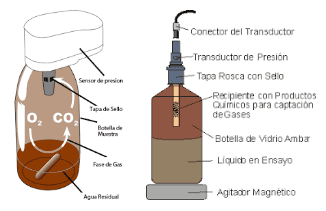
BOD20oxygen quantity (mg/l) consumed in the degradation of organic matter by biological means, after incubation of the water for 20 days at 20°C and in the dark. After about 8 days, biodegradation of nitrogenous organic compounds begins, due to the effect of the bacteria nitrifiers, with oxidation of 95-99% of the carbonaceous matter considered to be complete after 20 days.
When N, P and S are present in the organic material, the following reactions occur via the microbial flora:
Organic N + O2 ⇒ NO3¯ NO3¯
Organic P + O2 ⇒ PO4¯³
Organic S + O2 ⇒ SO4¯² SO4¯² S
BOD gives the amount of biodegradable organic matter present in a sample.without providing information on the nature of the pollution. A low BOD value does not necessarily indicate a low level of organic pollution, as there are substances that are difficult to biodegrade or even inhibit the biological process (toxic substances).
 Español Español
  English (UK)
 Português
 Français
 Italiano
 Deutsch
 العربية



2 responses
This is something on which I really have to prove to be a big test,
thanks for the publication
I simply must tell you that you have written an excellent and unique article that I really enjoyed reading.
I am fascinated by how well he presented his material and presented his views.
Thank you.