Table of contents: Organic matter III. Control strategies
The control strategiesl most appropriate for the reduction of organic matter in the greens and other areas of golf courses or natural grass sports grounds are as follows:
Receipts from sand: frequent and low doses are the best strategies for the dilution of organic matter and the achievement of firm surfaces.
Light recovery
The sand fillings ensure that the macropores are not closed by roots and biomass. Each light topdressing also improves surface imperfections caused by ball fall and traffic. The sand dosage must allow for grass growth as well as dilute the organic matter, and this will depend on the species involved, growth rate, soil conditions, traffic, etc. Excessive inputs can damage the blades and prevent good rolling of the ball. The total amount of sand applied has the greatest impact on the dilution of organic matter, (Vavrek 2007). Moisture and granulometry also play a major role in how it is incorporated under the turf blade.
Incorporation of sand under the leaf
It is therefore recommended to use dry sand, with a size range between 1- 0.25 mm and with a good uniformity coefficient (>2).
Aeration through hollowed-out spikes together with sand fillings: These operations physically remove organic matter and dilute it. They also decrease compaction and increase the saturated hydraulic capacity. The recommended numbers to keep organic matter below 3-4% are spiking operations that remove 15-20% of organic matter from the surface each year and incorporating 40-50 cubic feet/1000 square feet. The use of spikes smaller than 1/2 inch are difficult to fill, and more attention must be paid to proper incorporation. Always perform operations during periods of high growth, i-greenkeeping is a good tool for its determination.
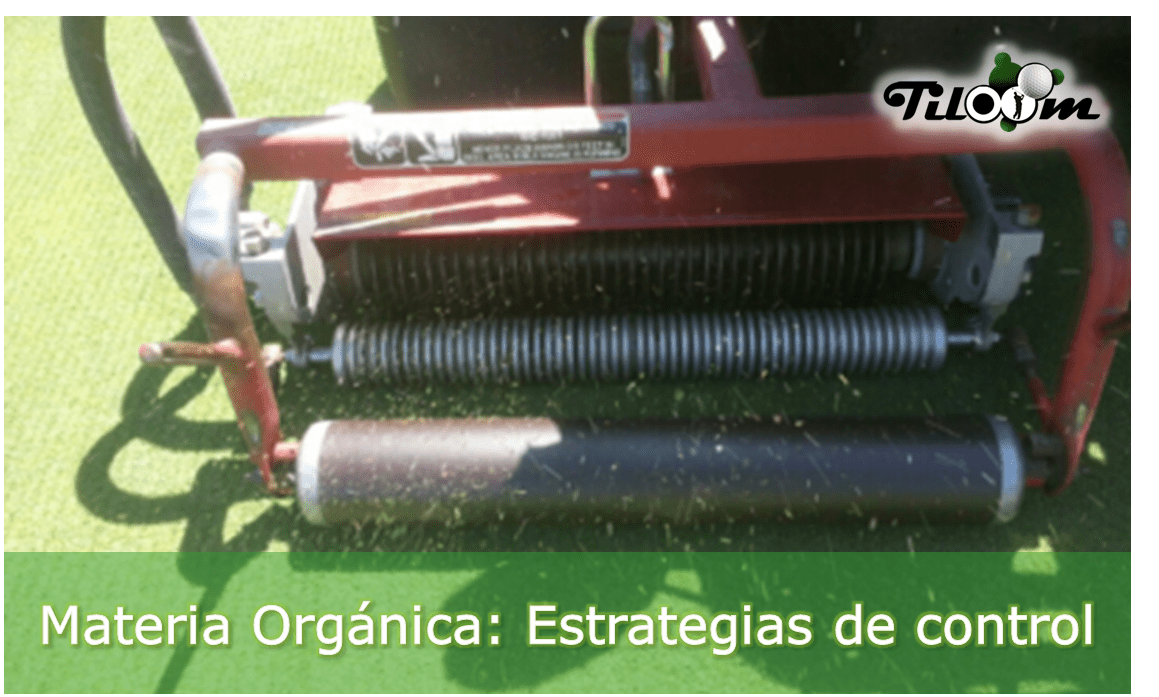
Verticut: This operation removes surface organic matter and scratches the surface for better introduction of sand. One millimetre of blade width can have an effect on up to 4% of the surface of the sand. green. Even deep verticals can remove more than a puncture. (Landreth et al., 2007).However, the elimination of organic matter is reduced to the first 2 cm of depth. In addition, recovery can be one to three weeks longer than that which would be produced by puncturing. (Landreth et . al 2007).. Pricking should not be replaced by actions of verticut.
Surface organic matter removal through vertical or vertical cutting
Solid pinchings with light coatings: are also very successful in removing organic matter but it should be noted that they will not correct stratification, low infiltration and compaction.
If you have already read Organic matter III. Control strategies you might be interested in...
We appreciate your interest in us, so we leave you this form so that you can subscribe and have priority access to our exclusive promotions and offersideal for saving money on your purchases and keeping your sports and agricultural fields at the forefront!
In addition, we will keep you informed about the LATEST NEWS in Greens and Agriculture with the latest entries from our Greenkeepedia and Agrikipediaincluding innovations, events and interviews with experts.




 Español
  English (UK)
 Português
 Français
 Italiano
 Deutsch
 العربية