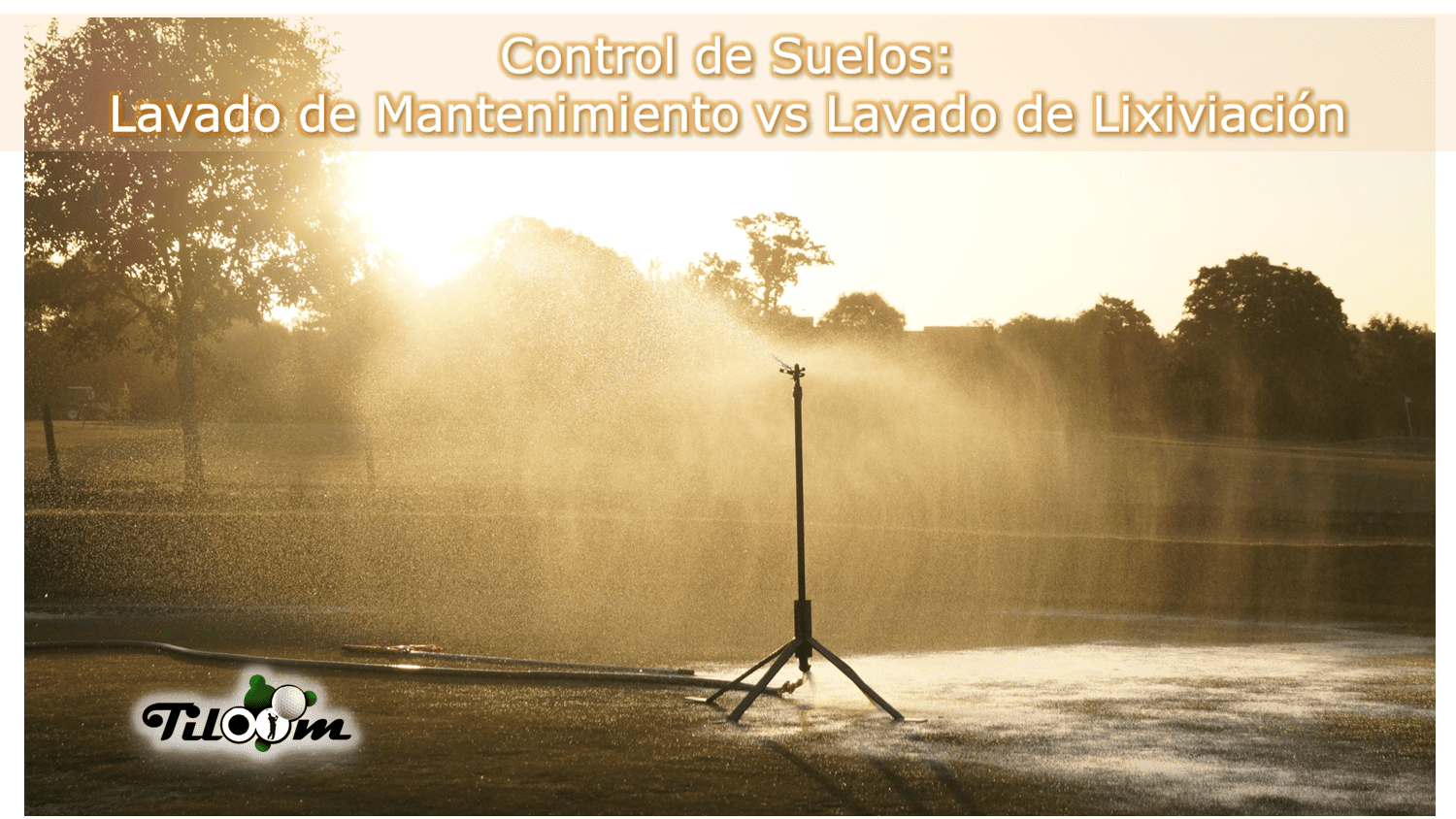
The way to control salinity and avoid toxicity in sporting grounds soils is through the use of the maintenance washes and leach washes. These techniques of irrigation are therefore used for the control of saline soils.
MAINTENANCE WASHING:
It consists of maintaining the soluble salts present in the soil at acceptable levels that do not affect the development of the crop, slowly moving them to deeper areas of the soil outside the area of root activity. To achieve this, it is essential to know the amount of water to be applied in an irrigation (according to Robert N. Carrow & Ronny R. Duncan)
- RC (ET + NL) CP
- CR= amount of irrigation
- ET= evapotranspiration
- NL= washing requirements (5-15%)
- CP= programme coefficient= irrigation system efficiency=1.1-1.3
According to Rhoades (1974): the washing requirement (NL) represents the minimum percentage of water that must pass through the root zone to maintain salts at an acceptable level for the crop. The NL is determined by the WATER QUALITY irrigation and the salt tolerance of the crop.
Watering only the root profile for long periods causes a serious accumulation of salts that must be flushed out.
LEACHING WASH
It is carried out when we are starting from an unacceptable level of salts in the soil for turfgrass development. It usually occurs in the following cases:
- turf establishment
- mismanagement of NL and/or CR
According to Rhoades and Loveday (1990):
- ECUATION Pw
- Pw depth of water for leaching or amount of water to apply
- K factor that varies depending on the type of soil and the way in which irrigation is applied
- Ps depth of soil to be leached
- CEe desired final soil salinity
- CEeo initial soil salinity
- CEw irrigation water salinity
According to Robert N. Carrow & Ronny R. Duncan (Best management practices for saline and sodic turfgrass soils 2012): the value of the K-factor varies depending on the type of soil and the way irrigation is applied.
- Sprinkler irrigation in cycles or intervals: the soil is not in a saturated state and the time between irrigation cycles is 1-2 hrs in sandy soils and 2- 8 hrs in fine textured soils.
K=0.05 soils with more than 95% of sand
K=0.1 rest of soils
- Continuous flood or sprinkler irrigation: the soil is in a saturated condition during the entire flushing.
K= 0,45 organic soils
K= 0,30 fine textured soils
K= 0,1 sandy soils
K= 0.05 fine rain
K= 0.1 heavy/torrential rainfall
Compared to other washing techniques, leach washing has the following disadvantages:
- more water than in maintenance washes
- plant growth is affected by excess salts
- may require the closure of machinery due to excess moisture or flooding of the surface.
You can control the salinity of your field with the instruments we distribute:
Make better decisions with us, our top quality services and our more than 15 years of experience in Football and Golf are our guarantee:


 Español
  English (UK)
 Português
 Français
 Italiano
 Deutsch
 العربية