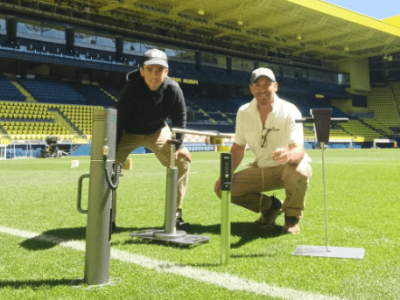


Darío Pascua Ponce is superintendent at the Polo Club of Boca Raton, Florida, USA.
We had the opportunity to chat with him and were pleased with how satisfied he is with the results he gets from his tool. POGOWe think it is interesting to bring here his testimony as a case of its use.
Tiloom: Dario, are you happy with POGO? Because I guess you work and use it in the US, right?
Darío Pascua PonceYes, this invention has got me out of more than one situation where other superintendents would have lost their jobs. It's like all technology: you have to pay for it. I have certainly improved many greens that were previously a headache.
Tiloom: I would love to know what particular problems it has enabled you to overcome, Dario... My intuition has always told me that it is a great tool for diagnosing deficiencies in irrigation networkI am looking for specific situations that have been experienced by those who have tried it to help other greenkeepers and to spread the word about the advantages of the product.
Darío Pascua PonceOne of the key things that POGO has helped me with is adjusting the irrigation on fairways and greens, and thanks to this I don't have to worry as much as I used to, especially in areas where there were very wet areas near hydrophobic areas.

The problem with these greens since the course was renovated in 2002 was that some of the greens had been irrigation heads were not adjusted for them. For many years it was normal that on certain occasions, when the weather dictated, a hose with a wetting tablet had to be taken out to combat the areas where these greens dried out.
Also, as a consequence of this, the WITCH RINGS that are always on the ground became visible, even causing grass loss if not treated in time.
Typical reactions were: "we have to treat the greens with Prostar" and how expensive that is; or "we have to fertilise to camouflage the witches' rings".
Hole number 15 is the best example, because when I returned to the Polo Club after four years, the same problems persisted, it was as if I had never left, but this time I knew I could fix the situation: I knew that by analysing the greens with POGO I would find out which irrigation heads I would have to adjust more time or on other greens change the irrigation head for another one that would allow me to adjust the arc. This was the case with the 15th green, which is not protected, but is oriented towards a lake and whipped by the wind that comes in from the back of the green towards the front, making the irrigation distribution deficient in some areas and very abundant in others.
<<Yes, this invention has gotten me out of more than one situation where other superintendents would have lost their jobs. It's like all technology: you have to pay for it.
The 15th green had a moisture deficiency in the soil on the back left, where a large portion was losing turf, as well as not having roots. After adjusting the head over time, the POGO measurements indicated that it was still not putting enough water where it should be and was putting more in other areas. The RainBird head was projecting the water too high and the wind was carrying it to other areas, which became clear when we analysed the green with the POGO, so we decided to change the head for the TORO 835S, where I adjusted the arc as low as possible to avoid the winds as much as possible. What I mean by this is that sometimes we let ourselves be guided by comments like "these greens have always had witches' rings" or "this green always loses grass in this area". It is so easy to see with the POGO where the water goes and how much water you have to put to avoid going to these extremes of losing grass or having visible witches' rings, when by maintaining an ideal humidity for each green you can avoid this.

The 15th green went from being the worst looking green before the season to one of the best in a matter of a couple of months.Since I made those adjustments, it doesn't keep me awake at night, it's just another green.
<>.
In the pictures showing how the moisture distribution was before and after the head change, you can clearly see that increasing the watering time was not the solution.
TiloomThank you for your testimony, Dario.
 Español Español
  English (UK)
 Português
 Français
 Italiano
 Deutsch
 العربية