🌟 Improve your sports field with a expert audit.

Soil Texture: Discover your soil type easily

Picture of Ignacio del Rey
Ignacio del Rey
View profile

Share on RRSS

Table of contents: Soil Texture: Discover your soil type easily

Knowing the soil texture of your field is essential for proper management of all cultural operations including irrigation, but sometimes the necessary means do not exist to send the sample to a laboratory and receive reliable results, or there is a hurry to know the result.

Sending samples to a laboratory is the most accurate way to know soil texture.

In such cases, there are methods to estimate the soil content in the soil:

  • Clay
  • Limo
  • Sand

1- The use of USGA sieves

Sieves are an accurate way of measuring in much the same way as in a laboratory. It is very useful to have sieves that allow you to divide the soil into its parts in order to know the texture accurately.

Separation of materials according to diameter with mechanical screens.

The procedure is simple, and I will summarise it below.

  • The first step is to dry the soil sample to be measured so that moisture does not interfere with the percentages and then the dry soil is weighed.
  • It is sieved in each of the sieves, the laboratories use standardised shakers so that the movement is always the same and the sample always has the same sieve.
  • Finally, each part is weighed to calculate the percentage of each soil according to its particle diameter.
Knowing the texture of the soil is essential for managing irrigation well and to know what the relationship between the irrigation water and soil.

2- Flexibility test

This process is very accurate for a field method without any instrumentation, as it estimates the content of each particle according to the plastic capacities of each material.

Plasticity test of soil materials.
  • A soil sample moistened with water is made into a ball with a diameter of 3 centimetres. Drop it on the ground, if it crumbles completely, it is a sandy soil, and if it holds its shape moderately, go to the next step ↓↓↓↓.
  • With the same ball, try to make a cylinder of 7 centimetres in diameter. If this is not possible, you are dealing with a sandy loam soil; if it is possible, carry out the following step ↓↓↓↓.
If during rubbing the floor dries out due to the environment or contact with hands, it can be slightly moistened until it becomes malleable again.
  • If this is not possible, we are dealing with a sandy loam soil, but if it is, we continue to the next step ↓↓↓↓.
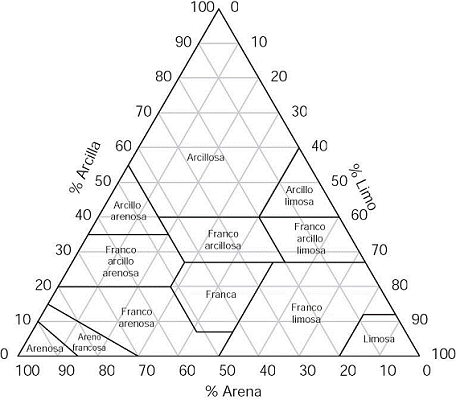
Triangle of textures.
  • This is the moment to try to make a semicircle with the 15 cm cylinder that was formed earlier, if this is not possible, it is a loam soil.
  • If the previous step was successful. The circle must now be closed, if it breaks when trying to do so, it is a heavy loam soil, i.e. it has some clay. If you can close it but it cracks, it is light clay, and if it closes without problems, it is a very clayey soil.

3- Manson Jug Test

This is another simple method that is somewhat slower than the previous one, as it requires a 24-48h rest period, but its results are reliable.

It is only necessary:

  • Soil
  • A transparent canister
  • Clean water

After taking samples from the area we wish to study, simply place the sample in a transparent jar until it is one third full and fill the rest with water. Shake vigorously, making sure that all the particles are wetted and distributed, leave to stand until the solids are precipitated at the bottom of the jar, normally one day will be enough, although if it has a high clay content this time may be longer. Gravity will do the necessary work to separate the materials according to the mass of the particles. The largest and heaviest particles will be the first to precipitate until the smallest ones precipitate higher up.

At Tiloom we have the best sieves for professional and high quality soil separation.

Then it is only necessary to measure the height of each of the horizons to determine the volume percentage of each of the parts. The method is very simple and economical and gives very reliable results.

To finish the work, simply use the texture triangle to enter each value in each edge and cross the three points in the area that represents the specific texture of the studied soil.

The FAO has a great guide where you can see more methods.

If you have already read Soil Texture: Discover your soil type easily you might be interested in...

Other articles by Ignacio del Rey:

Didn't find what you were looking for?

Leave a Reply

Your email address will not be published. Required fields are marked *

Contact with us

Hello! Do you have any questions or queries?

Please fill in the following form so that we can help you as quickly as possible, thank you very much.

You can also contact us through the following links:

Hi! You've been with us for a while now and ....

in villareal tiloom field

We appreciate your interest in us, so we leave you this form so that you can subscribe and have priority access to our exclusive promotions and offersideal for saving money on your purchases and keeping your sports and agricultural fields at the forefront!

In addition, we will keep you informed about the LATEST NEWS in Greens and Agriculture with the latest entries from our Greenkeepedia and Agrikipediaincluding innovations, events and interviews with experts.

Click to subscribe now and get exclusive access!