
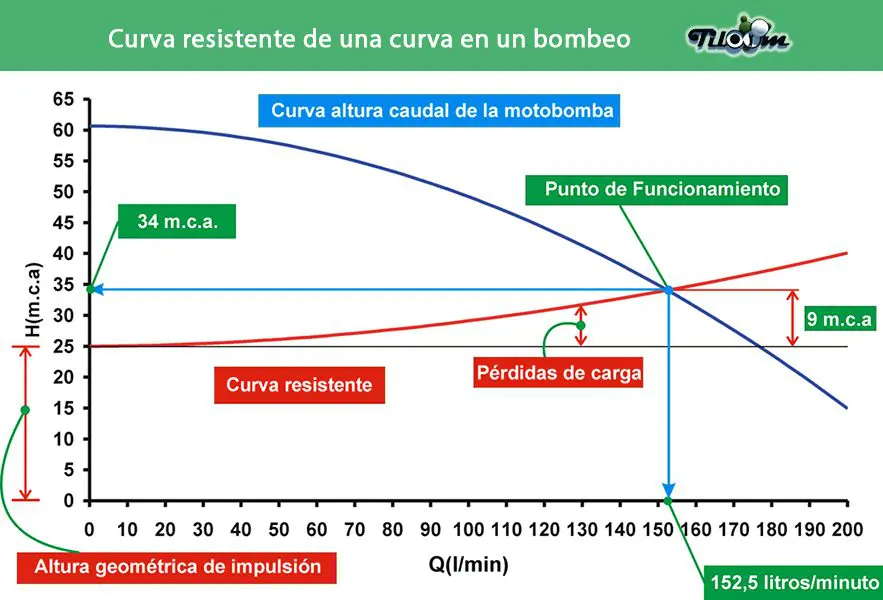
In order to determine the head required by a pump, or group of pumps, at which it is capable of lifting given flow rates, it is necessary to determine the system resistance curve.
The system resistance curve represents the total head points (geometric head plus losses) that occur in the system at different flow rates varying from zero to the maximum expected value.
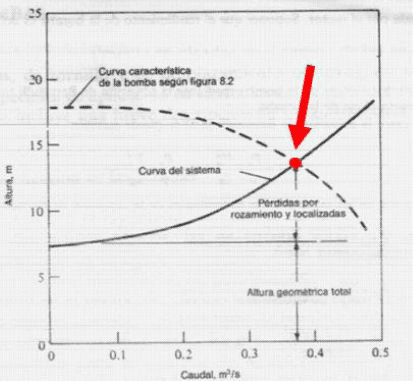
The operating point indicates the flow rate and head that can be lifted in a given system with a specific pump. In order to determine the resistance curve of the system, in addition to knowing the total geometric head, we must calculate the value of the system losses.
The operating point should be that of maximum performance. At this point the radial forces on the bearings are minimal. These radial forces increase as we move away from the point of maximum performance operation.
When the pump flow rate increases above the maximum output, the absolute pressure required to avoid the cavitation increases, on the other hand, if the pump flow rate drops towards the closed valve point (zero flow), liquid renewal problems occur causing overheating, cavitation in the impeller, as well as vibrations.
Do you know Rigometer? Pumping will never be the same again.
 Español Español
  English (UK)
 Português
 Français
 Italiano
 Deutsch
 العربية