Table of contents: Profiles of greens. Salt and water movement
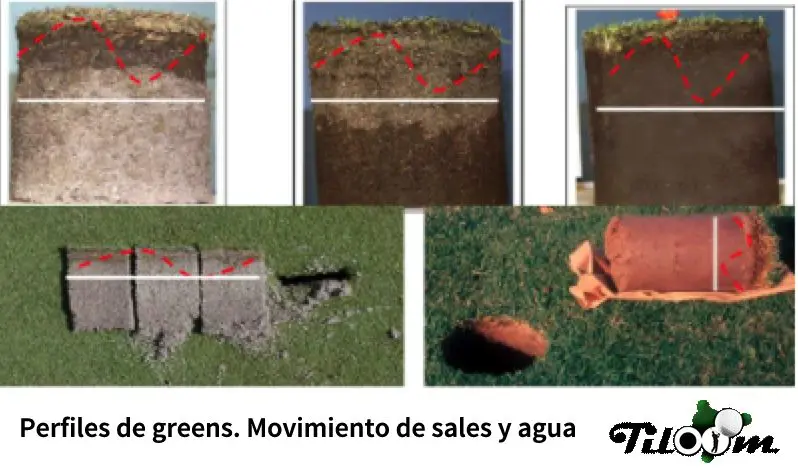
The profile of the greens from the surface to the interior is not homogeneous, its movement of salts and water changes a lot. The upper part of the greens is characterised by the great majority of plant matter, from the crown and stems to the great majority of the roots. This different composition in the first 6 cm or 2.5 inches from the rest of the profile therefore has very important physical effects.
The measurements obtained by the different sensors along the profiles are constant, but the behaviour of the salts and water in these profiles is not. Therefore, the measurements provided by the sensors throughout the profile they cover give us information on their average, diluting the average for the upper zone and increasing it for the lower zone. In reality, since the vast majority of the volumetric moisture content and the Electrical conductivity takes place in these first 6 cms, it is the most important area to monitor.
No matter which substrate is present, the situations are repeated even for soils with high clay content, it is the natural behaviour of these systems. The movement of salts and water is caused by physical phenomena such as transpiration, generated by a moisture gradient from the zone with more moisture in the lower zone to the upper zone with less moisture, and gravitational movement, generated by gravitational forces, resulting in constant variations.
Studies carried out by Stevens in different locations around the world, for different compositions of greens substrates, with different root depths or varieties of grasses, show that these processes are constantly repeated.
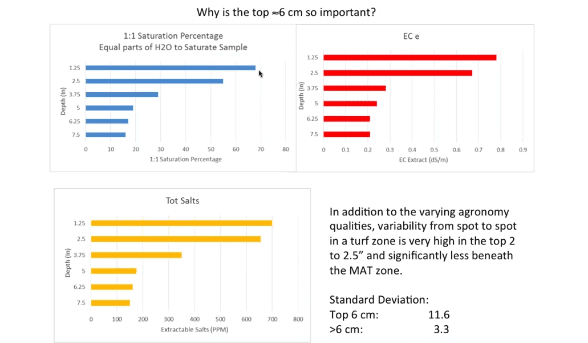
See the influence of the different parameters depending on the depth of the profile:
Variation and study of measurements on different soil profiles every 2.5 cm.
Chemistry also has a different behaviour in the first cm compared to the rest of the soil profile, the cation exchange that takes place in the first cm is much higher than in the area immediately below. The most important reason for this is that the cation exchanges that take place between water and soil matrix are due to the differences between the two chemistries, as well as thermodynamic phenomena. As the irrigation water penetrates the soil profile, the pore water starts to exchange very intensively with the soil matrix, because there are many differences between the two chemistries, so as it penetrates deeper, the differences become smaller and so do the cation exchanges.
Hydrogeochemical modelling by Tiloom shows these differences, with cation exchanges in the order of 10 times higher in the upper profiles than in the immediately lower ones. See differences between the shallow A horizon and the immediately lower B horizon; a constant and similar CO2 partial pressure was simulated for both cases.
Exchange of the order of 10_3 meq/kg in first 6 cms
Cation exchange of 10_4 meq/kg soil, an exchange capacity of at least one order of magnitude lower
If you have already read Profiles of greens. Salt and water movement you might be interested in...
We appreciate your interest in us, so we leave you this form so that you can subscribe and have priority access to our exclusive promotions and offersideal for saving money on your purchases and keeping your sports and agricultural fields at the forefront!
In addition, we will keep you informed about the LATEST NEWS in Greens and Agriculture with the latest entries from our Greenkeepedia and Agrikipediaincluding innovations, events and interviews with experts.




 Español
  English (UK)
 Português
 Français
 Italiano
 Deutsch
 العربية