
Factors affecting salt accumulation in soils
 PHOTO · TILOOM

Author: Jimena Blanco
Why does salt accumulation occur in soils?
Salinisation of a soil occurs due to the accumulation of salts. In a grass crop, salinity stress occurs when there is an accumulation of salts in the soil. continuous supply of soluble salts and/or sodium (Na) and/or Boron (B) in irrigation water and the necessary work is not done to alleviate their symptoms.

The main factors affecting salt accumulation in turfgrass are:
- Salinity tolerance level of the different varieties and species
This is a determining factor when choosing which lawns to plant depending on the type of grass. irrigation water quality.
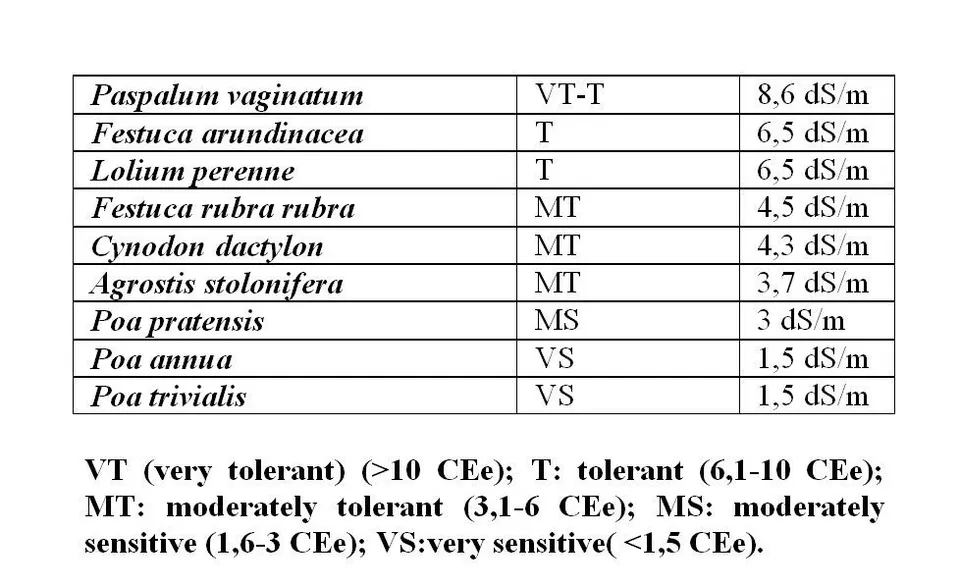
According to Carrow R. N and R.R Duncan. Salt affected turfgrass sites: Assessment and Management, the following table represents the salinity tolerance of different species and varieties of lawns.
- Climatic conditions
Throughout the year there are large fluctuations that will condition the amount of water to be supplied to the crop. When irrigating with salt water, the total amount of water will depend on the evapotranspiration daily, of the washing needsand of the irrigation system efficiency. In summer, when rainfall is low and evapotranspiration is high, irrigation needs increase and with it the risk of salt accumulation if we do not manage it well.
- Type of salts present
Soluble salts: their presence determines the electrical conductivity (EC) in the saturated soil extract (ECs) and in water (ECw).
Sodium: its concentration is measured by the SAR (sodium adsorption ratio) of the soil, SARw of the water and RSC (residual sodium carbonate).
Boron: Due to the different sources, it is common for water to contain high levels of this element. It accumulates at the leaf tip and it is good practice to collect mowing debris to reduce its concentration in the plant.
- Type of soil
Due to the breadth of this topic, in this article we will only highlight the fact that the sandy soilscharacterised by low cation exchange capacity, lower compaction capacity, higher presence of macropores and higher infiltration rate. They are easier to wash and require less water than clay soils, which are more sensitive to compaction, rich in micropores and have a lower infiltration rate.
- Irrigation water quality
It affects both crop production and the physico-chemical conditions of the soil. The parameters that determine the quality of irrigation water are physical, chemical and biological. Throughout the year, it is important to carry out periodic analyses to determine possible changes in water quality in order to determine more accurately the needs for flushing salts from the soil and to optimise irrigation.
- Irrigation scheduling
When irrigating with salt water, it is important to make abundant and deep irrigations to move the salts below the root zone or to keep them at least at acceptable levels for the plant. Light, frequent watering encourages the accumulation of salts on the soil surface and their absorption by the plant.