🌟 Improve your sports field with a expert audit.

Identification of caespitose species - General

Picture of Ignacio del Rey
Ignacio del Rey
View profile

Share on RRSS

Table of contents: Identification of caespitose species - General

The identification of cespitose species is an art in itself, because who is lucky enough to go to a field and be able to identify the plants with a whole specimen? You have to rely on small details that we will explain in this post.
Important areas of identification
In order to carry out optimal maintenance, it is essential to know for sure which species are present on the surface, but this is not always the case. Let's identify species!

The needs for fertilisation, mowing and irradiation, or resistance to insects, disease or stress change greatly from one species to another, although within the same species, thanks to the new varieties that come onto the market every year, there are also important changes.

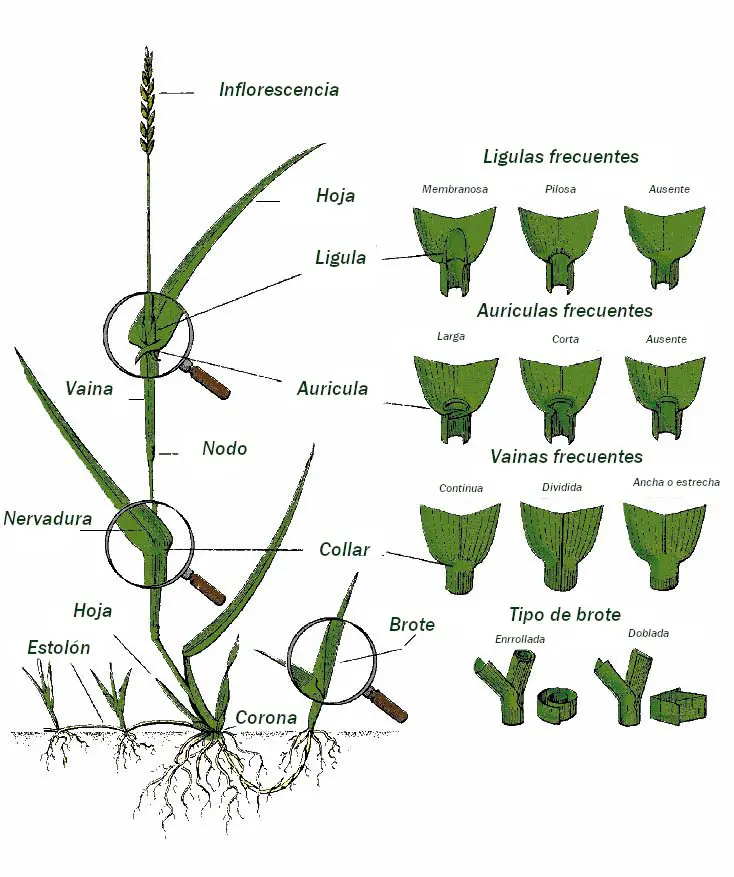
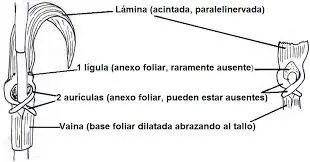
Parts of a grass

It is very important before making the identification to take into account factors other than the shape of the plant directly; it will be difficult to find a vigorous C4 Cessus in the cold season, or a vigorous C3 in the warm season with a strong growth. It should also be taken into account that a species with little tolerance to salinity may be in a very saline soil in good conditions or a grass with little tolerance to shade may be growing without problems under dense trees.

1- Ligule; located between the leaf blade and the upper end of the sheath.

  • Membranosa -> Agrostis stolonifera(creeping bentgrass) and Poa pratensis (Kentucky-bluegrass)
  • ciliated or hairy -> Zoysia
  • Absent -> Absent -> Absent -> Absent -> Absent -> Absent -> Absent -> Absent -> Absent Echinochloa

2- Auricles; located between the leaf and the sheath.

  • Long -> Long -> Long -> Long -> Long -> Long -> Long -> Long -> Long -> Long -> Long -> Long -> Long  Lolium multiflorum
  • Short -> Tall fescues
  • Absent -> Absent -> Absent -> Absent -> Absent -> Absent -> Absent -> Absent -> Absent Agrosts and Bermuda

3-Vaina is located between the leaf and the stalk

  • Continued -> Stenotaphrum secundatum
  • Divided -> Bermuda and Red fescue
  • Broad -> Agrostis gigantea
  • Narrow -> Tall Fescue

4-Sheet

  • Sharp -> Red fescue
  • Rounded -> Poa Pratensis
This list is just one example of all the variables that come into play when it comes to accurately defining a species. Some works such as the famous "Bonnier", also known as "Key to the determination of vascular plants" contain a complete guide to identify almost any species.

There are other variables that can also be very interesting to look at when identifying species. Very broad leaves are related to Stenotaphrum secundatum or Axonopus and narrow leaves have more to do with Stenotaphrum secundatum or Axonopus and narrow leaves have more to do with Stenotaphrum secundatum. Agrostis stolonifera or fine fescues. Rarely can we see the inflorescences of the grass, but for example the Poa Annua can develop inflorescences even at very low cutting heights.

Plant development can be modified by all possible biotic and abiotic variables, the light it receives, its fertilisation, its location, whether it has grown among other plants or on the edge of a path. The best observations are therefore made on the basis of the inflorescence and the shape of the seed, although in the turf world we can rarely see such organs.

Digital Macroscope

IPM Scope Turf Microscope

If you have already read Identification of caespitose species - General you might be interested in...

Other articles by Ignacio del Rey:

Didn't find what you were looking for?

Leave a Reply

Your email address will not be published. Required fields are marked *

Contact with us

Hello! Do you have any questions or queries?

Please fill in the following form so that we can help you as quickly as possible, thank you very much.

You can also contact us through the following links:

Hi! You've been with us for a while now and ....

in villareal tiloom field

We appreciate your interest in us, so we leave you this form so that you can subscribe and have priority access to our exclusive promotions and offersideal for saving money on your purchases and keeping your sports and agricultural fields at the forefront!

In addition, we will keep you informed about the LATEST NEWS in Greens and Agriculture with the latest entries from our Greenkeepedia and Agrikipediaincluding innovations, events and interviews with experts.

Click to subscribe now and get exclusive access!