

The turbidity in treated water is an indicator parameter for the water transparencyThe more suspended solids there are, the "dirtier" the water appears and the higher the turbidity. The more suspended solids there are, the "dirtier" the water appears and the higher the turbidity. Suspended solids are, in turn, a fraction of the total solids in a water sample.
The turbidity value is measured in NTU units: Nephelometric Turbidity Units. The instrument used for its measurement is the nephelometer o turbidimeterwhich measures the intensity of light scattered at 90 degrees when a beam of light passes through a water sample.
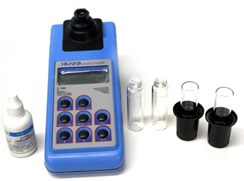
Different conditions affect the level of turbidity: turbidity content organic matterphytoplankton and mainly nitrogenous forms, etc....
The detrimental effects are several:
Studies carried out by the biologist Ramón Fernandez Pinilla, in order to remove turbidity from the water, indicate that salinity is closely related to this parameter. When salinity increases, turbidity decreases and when salinity decreases, turbidity increases. Salt inhibits the growth of the populations of bacteria nitrifiers that produce turbidity.
Turbidity on the other hand affects herbicide treatments, according to the U.S. EPA (United States Environmental Protection Agency) the maximum level should be 5.0 NTU, Patrick Mccullough Ph. D. University of Georgia, USA".Maximizing Efficacy of Herbicides for weed control in Turfgrass Management“.
 Español Español
  English (UK)
 Português
 Français
 Italiano
 Deutsch
 العربية