
Planimetry is the determination of the shape of a built surface. For example, a football pitch is currently seen to have an apparently perfectly horizontal layout, but in reality it hides gabled or hipped slopes of less than 1%.
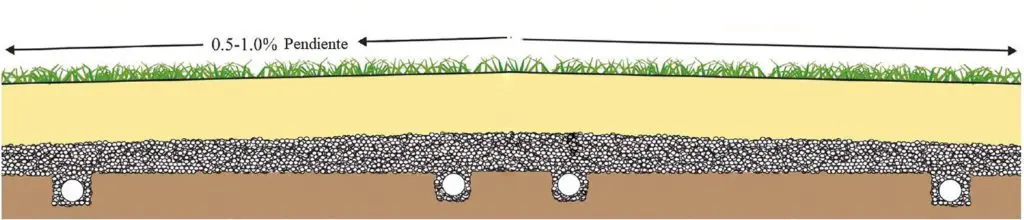
During the construction of a field, the target planimetry is ensured when the surface is shaped with a tractor controlled with a laser self-levelling machine. But as time went by, with the punctures and scuffs, recebados or the removal of material using various milling machines or “rotary tillers” can gradually alter these gradients.
Without the existence of slopes, there would be deficiencies in the evacuation of water in episodes of intense rain, waterlogging in areas of low infiltration, etc., while excessive and irregular slopes result in fields with poor playability, difficulties in the movement of the ball and visually deficient.

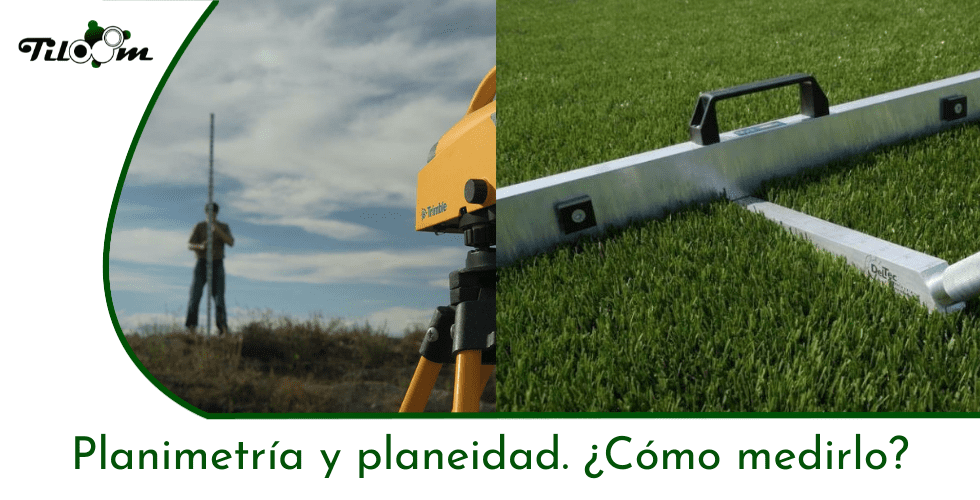
The general flatness of the field can be checked with a simple optical level. With this type of tool you can clearly assess whether the slopes of the field are correctly maintained.
The optical level uses basic trigonometry to determine distances and angles, so that segments and differences of dimensions can be calculated, essential ingredients in the calculation of dimensions.

On the other hand, the general slopes of the pitch do not necessarily have to be seriously distorted, but small troughs and hills on the pitch are very common. These sunken or raised areas hinder the players' running, change the direction of the ball and cause waterlogging which can lead to serious black layer problems.
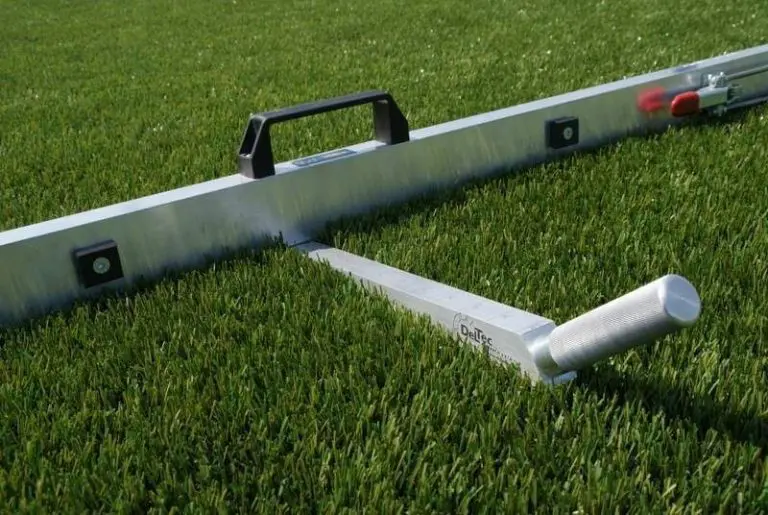
The standard straight bars have been developed to measure surface evenness. This device is used to identify high and low areas of the field. Our equipment is collapsible and its seals are made from synthetic fibres with strong locking mechanisms to prevent backlash.
In addition to the included millimetre wedge, the deviation from straightness can be measured and subsequently corrected with a small grinding or rollers. The measurements are in accordance with FIFA regulations, in which reference is made to the European standard NEN 13036.
In order to improve the quality of our pitches, we must pay attention to these details, so that we can achieve long-lasting, professional pitches that are easier to maintain.


If you want to know more about the measurement tools Trimble, Spectra or Enterprise professional sensors distributed by Tiloom or about our measurements please contact us at info@tiloom.com or on our website.
 Español Español
  English (UK)
 Português
 Français
 Italiano
 Deutsch
 العربية