

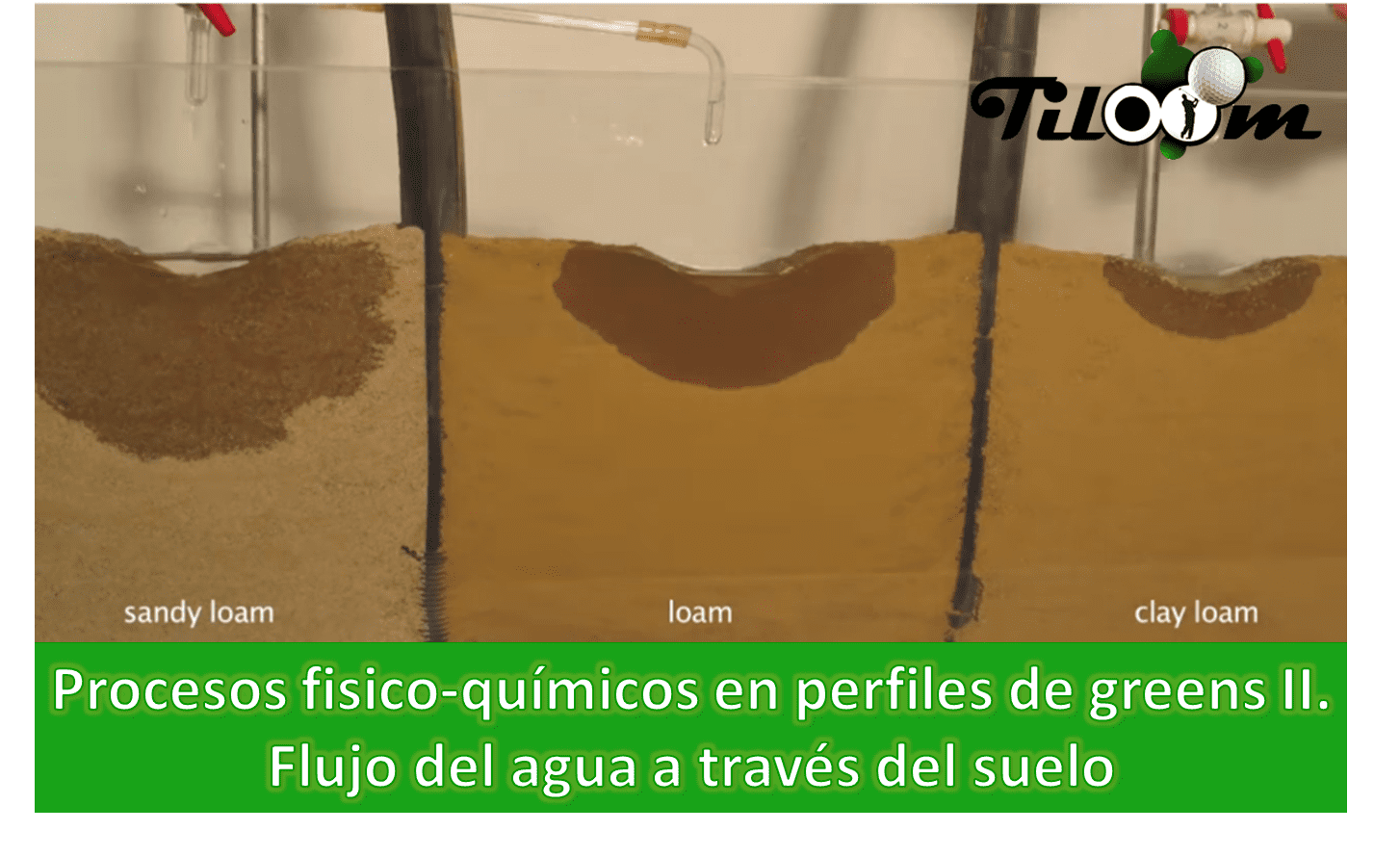
How does water flow through the soil? What are its variables? Texture, salinity, type of water, surface tension... Many factors interfere in the process, and can even stimulate the infiltration of water through the soil.
The movement of the water descends first by gravitational potential, but it is not the only driver. As it descends, because of its hydrogen bonds, the water molecule is held together with other water molecules by cohesion, but at the same time it adheres to other surfaces and soil particles by accession.
Before the ground becomes saturated (a condition that occurs after the infiltration test,watering or heavy rain), the water descends filling all the pores, moving in any direction. Once saturated, the downward movement will begin to predominate according to the maximum moisture gradient (Matric Potential) and favoured by gravitational forces.
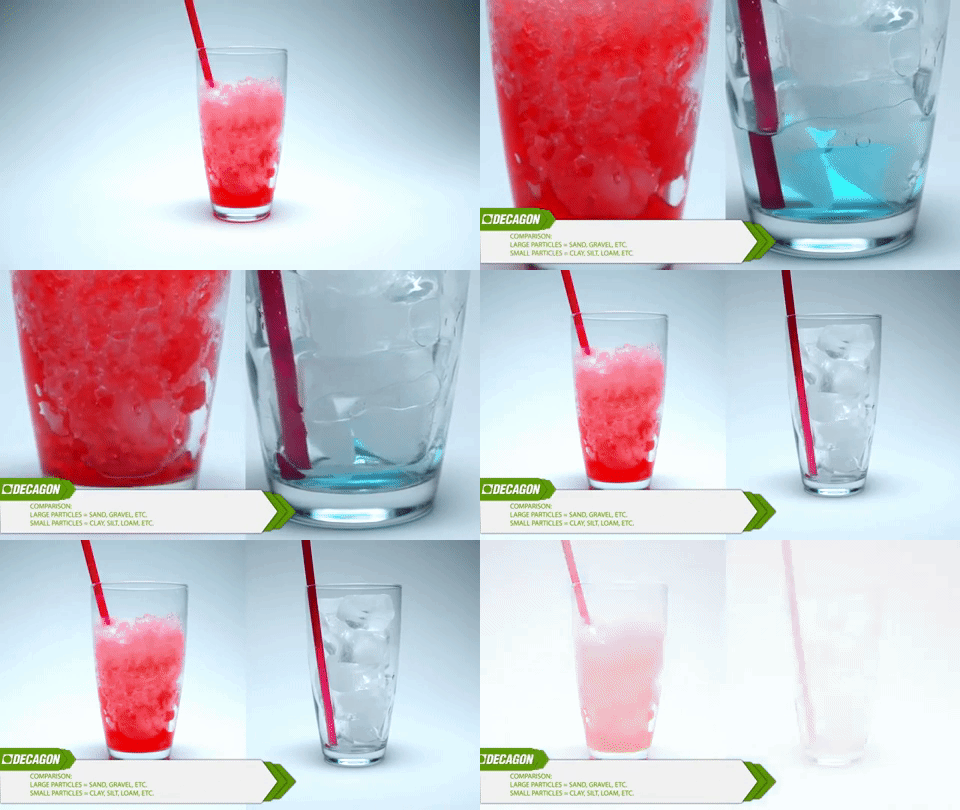
The infiltration rate of water into the ground will progressively decrease as the soil becomes saturated. soil profile to a constant value given by the infiltration rate. Gravels and sands have the highest velocities, decreasing as the particle size decreases, and silts and clays have the lowest velocities. Each soil, due to its complicated structure, each material has a very different infiltration value.
We can observe the characteristics of this water movement in the following link: https://t.co/8H0Dj05MrQ
All these forces are in turn related to the surface tension of the pore water. Surface tension can be defined simply as the ability of water to wet. The lower the surface tension, the easier it is for water to flow down to the lower parts of the soil profile, with the consequent washing out of salts that are in solution in the pore water.
These adhesion and cohesion forces can be reduced by lowering the surface tension of the irrigation water, thus avoiding the maintenance of high levels of VWC in the soil profile. The advantage is that it avoids anaerobic conditions and the possibility of forming black layers.

Today, the versatility of the various moisturising agents from ICL to improve the washing of salts or even eliminate possible dry spots
The optimum moisture status under normal conditions for the soil profile will be that which maintains a balance between the volume of water and the volume of air. Moisture retention curves represent how the two volumes balance as the soil is moistened. These curves will depend on the texture of the different substrates.

The graph above depicts a model showing the relationship between the soil water potential (x-axis) y the VWC% (y-axis) for a green built to specification USGA. In particular a sand ratio with the coarse textured 45% and medium textured 55%, the total porosity is 40% and the bulk density 1.59g/cm3. The optimum moisture in this case for a good equilibrium would be given by 22%, which can be easily measured either through the probes of Pogo of StevensWater or the TDR of Spectrum.
Tiloom currently distributes both coaxial capacitance tools and coaxial capacitance tools. Pogo or Spectrum's TDRs, with which you can easily obtain the ideal VWC % points for your sports surfaces.
In order to carry out our surface quality work, at Tiloom we use software from hydrogeochemical analyses. In doing so, we make exponential use of the laboratory analysis.
 Español Español
  English (UK)
 Português
 Français
 Italiano
 Deutsch
 العربية





2 responses
I think it is a good technology. How are the results on football pitches in the American tropics?
Wetting agents are very powerful tools in all types of soils as they decrease the cohesive and adhesive forces of water, so that dryness due to poor infiltration or hydrophobic materials is greatly reduced.
On the other hand, nowadays, having tools for reading soil moisture is essential for any professional as it greatly facilitates water management and irrigation of a field.
These tools are of great use in the fields at all latitudes of the planet.
I hope I have helped you with your questions. .