


The organic matter present in the profiles of our sports surfaces in minimal percentages, they help the retention of water and nutrients and provide resilience to the putting greens. On the other hand, an excess causes clogging of the pore space and prevents free movement through the soil, resulting in "shaving", "cushioning" and soft surfaces, inconsistency in the rolling balling, moss growth and high damage due to ball impacts or "piques".
The best way to monitor the organic matter content of the soil profileThe analysis of different samples at different depths. Analysis of a single sample will not reveal good information about its content and physical properties.
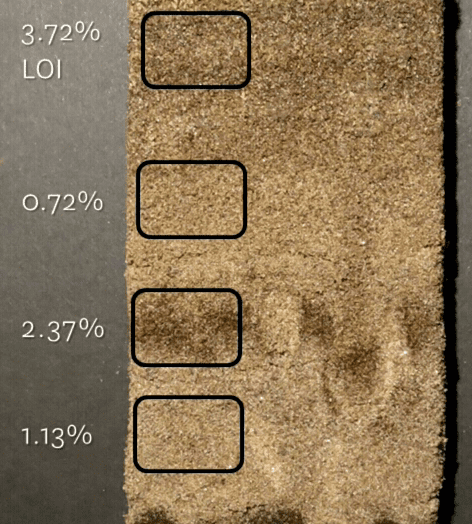
The determination process involves drying the sample at 105 degrees Celsius to eliminate all the moisture. Subsequently, this dry sample, which has mineral and organic content, is weighed and placed in an oven for (at least) two hours at 360-440 ºC, thus eliminating the organic matter by calcination. When the sample cools down (up to 150ºC) it is weighed again, before it starts to absorb moisture from the environment.
The difference between the weights before and after the oven gives the weight of organic matter, which can be expressed as a percentage of the weight of the sample. It is important to always carry out the analyses with the same laboratory to avoid inconsistencies in the results.

One way of diluting the organic matter content is to carry out light and frequent topdressing, although it makes even more sense to use tools for calculating nitrogen doses based on growth needs, such as the tool I-Greenkeeping.
Other aspects to be taken into account are the influence on the saturated hydraulic conductivityThe number of new cases is usually reduced by up to 10% after 6 months after the creation of a green (Murphy. J.W (TGIF Record 28098) and Nelson, S.H (TIFG Record 1305)) and up to more than a 30-40 % decrease from the original conditions due to the accumulation of organic matter after two years (Neylan, J. 1994 "Sand profiles and their long term performance" Golf and Sport Turf Australia). McCoy recommends a maximum of 3.5% organic matter and warns that macroporosity declines from these values.
Factors that increase the organic content of our sports surfaces are as follows:
Robert N. Carrow "Surface Organic Matter in Bentgrass Greens" USGA. Turfgrass and Environmental Research Online.
 Español Español
  English (UK)
 Português
 Français
 Italiano
 Deutsch
 العربية


3 responses
I really liked your approach to the blog. I would like to comment that I agree with your approach to the 360 degree evaluation process.
From the experience you have had with the 360-degree evaluation, I think that
it is quite important to plan adequately in order to obtain the best possible results.
results we want, e.g.; correctly selecting the right competences
that are required to be assessed according to the job profile.
I am very grateful to the author.
excellent article, about the amount of organic matter in soils, methods of measurement without special equipment, what could be the best way to measure the amount of organic matter in soils.
Dear Francisco, thank you very much for your comment. The best way to determine it is certainly through laboratory analysis, and as main characteristics you could observe that the higher the percentage of organic matter, the lower the infiltration rate of water in the soil profile, the lower the hardness or firmness values and the higher the soil moisture values.