

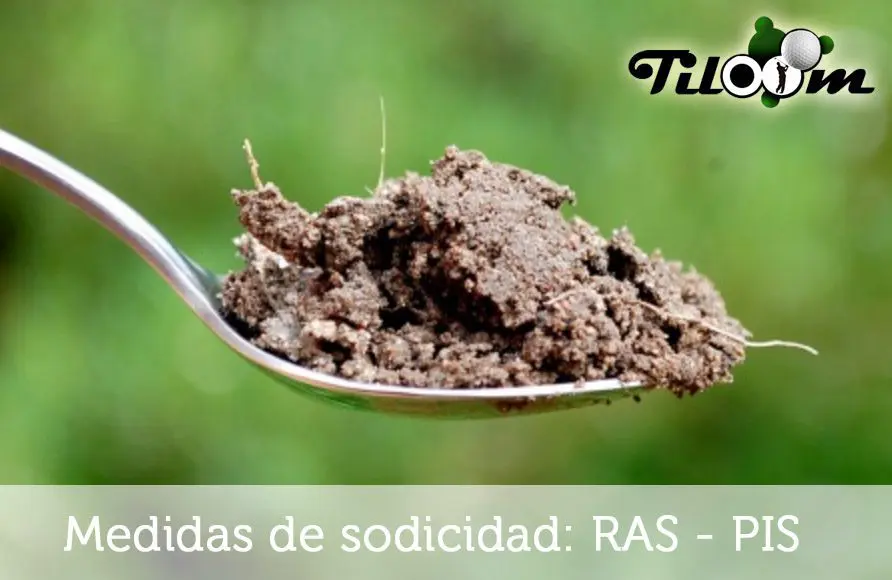
Sodium is found in the soil in a combined state and mainly in the form of salts. An excess of sodium in the soil causes a deterioration of its physical and chemical properties and impacts directly or indirectly on crop yields, as it has dispersing effects on soil colloids, affecting its structure and permeability. Their effects depend not only on their own concentration, but also on that of the other cations.
The sodium concentration can be measured either in the soil solution or in the exchange complex. In the first case it is called the sodium adsorption ratio (SAR) and in the second case the exchangeable sodium percentage (ESP).
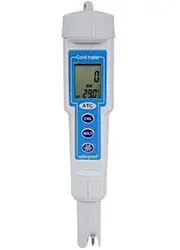
FieldScout Direct Soil EC Meter
It denotes the relative ratio of sodium to calcium and magnesium, divalent cations that compete with sodium for exchange sites in the soil. Its value is measured in milliequivalents/litre (meq/l). According to Richards et al., (1954) is determined by the following formula:

To calculate the PSI, the exchangeable sodium content and the cation exchange capacity (CEC) of the soil need to be determined. It represents the percentage of sodium relative to the other adsorbed cations and is expressed as a percentage:
PSI = 100 x Na / CIC (cmol/kg or meq/100gr)
According to Massoud (1971) we can classify soils according to their PSI:
|
PSI |
SOIL ASSESSMENT |
|
< 7 |
Non-sodium |
|
7-15 |
Slightly sodium |
|
15-20 |
Moderately sodium |
|
20-30 |
Strongly Sodium |
|
> 30 |
Extremely sodium |
Both parameters can be related as follows (USSL,1954; Naidu et al.,1995)
PSI= 1,475 (SAR) / 1+ 0,0127 (SAR)
CLASSIFICATION OF SALINE SOILS ACCORDING TO THE U. S. SALINITY LABORATORY
| SOIL | CONDUCTIVITY
ELECTRICA |
PSI | SAR | pH |
| SALINO | ≥ 4,0 | ˂ 15 | ˂ 12 | ˂ 8,5 |
| SODICO | ˂ 4,0 | ≥ 15 | ≥ 12 | ˃8,5 |
| SALINO-SODIUM | ≥ 4,0 | ≥ 15 | ≥ 12 | ˂ 8,5 |
SOURCE: Best management practices for saline and sodic turfgrass sitess. Robert N. Carrow & Ronny R. Duncan
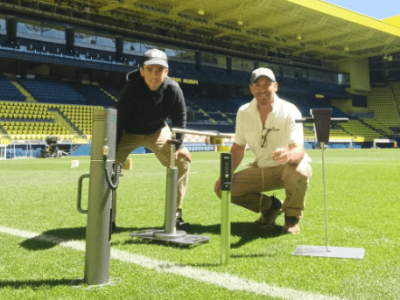
Portable equipment is available to measure directly on the ground. Their cost is low for the benefit that any field can obtain in return.
To determine the sodium content in either of its two indicators, we recommend performing a laboratory analysis of soil, which is very common in golf courses, football pitches and agricultural land.
 Español Español
  English (UK)
 Português
 Français
 Italiano
 Deutsch
 العربية




15 responses
It is good that you publish this kind of information, which is sometimes not so readily available.
It is a tool that helps us to quickly and safely calculate a soil analysis result for decision making.
How do they make PSI determinations at laboratory level. I have one and they ask me for this determination. I only do basic soil analysis, I have not yet incorporated this determination. I am grateful for your collaboration!
Hello Lucila
The calculation of PSI requires the determination of the exchangeable sodium content and the cation exchange capacity (CEC) of the soil, i.e. it is an indirect calculation based on the determination of two other parameters: Na and CIC.
Excellent tips on how to interpret the analysis.
HELLO GOOD AFTERNOON. HOW DO I TRANSFER FROM Na IN ppm TO meq/100g. I NEED TO CALCULATE PSI BUT I HAVE THE SODIUM VALUES IN ppm.
To convert ppm sodium to meq per litre:
Divide the ppm by 23, which is the weight of the element.
To convert to meq per /100gr, the same procedure but divide the result by 10.
Carolina
mgNa/1000 grams *( 1meqNa/23mgNa)
meqNa/1000grams Divide by 10 in the numerator and in the denominator and you have meqNa/100grams of soil.
Greetings
Jorge
If we know that values above 7 PSI are considered to be indicative of sodium problems.
What would be the reference levels for HRH?
It depends on the type of irrigation, but generally a SAR of 3 is safe for the crop, from 3 to 9 it is important to keep an eye on the behaviour of the soil and vegetation cover. From 9 onwards the risk is high.
Best regards, I hope I have helped you.
One question, how can I find the RAS experimentally, please?
An analysis of the irrigation water is needed. You can always orientate yourself with water salinity sensors, but you do not measure the RAS directly.
https://www.tiloom.com/producto/medidor-de-ec-de-suelo-directo/
Best regards.
Hi. The determination of the PSI by the Massud and USSL equations are very different. Massud 57 and USSL 13. It is a clay of pH 8.51. CEC 50 and Na 28.5. Conductivity 10.8. Do I consider it Saline or sodium-saline according to USSL or according to Mssud Extremely sodium? Thank you very much!
In case it is not a soil monitoring but a water monitoring, what would the PSI with values equal or higher than 7 indicate? in case it is a groundwater sample being more precise.
Hello, Good information for teaching soil chemistry class.