

The saturated paste extract (SPE) test consists of the extraction of a small fraction of the nutrients present in a soil sample. This laboratory test was developed by the U.S. Salinity Laboratory in 1954 for the purpose of determining electrical conductivity (ECe) and sodium adsorption ratio (SAR). It is the standard procedure for these determinations and the vast majority of scientific articles that discuss such information as indicators of soil quality are based on these parameters.
The method consists of bringing the soil sample to saturation with distilled water for an estimated two hours to reach equilibrium. The soil solution is then extracted by means of a vacuum pump, after the sample has been filtered.
The relevant information obtained is as follows:
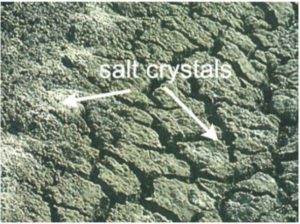
1. Electrical conductivity (ECe)measured in units of decisemens/meter (dS/m) or millimhos/centimeter (mmhos/cm). It gives an estimate of the total dissolved salts (TSS), for which the ECe value is multiplied by 640 to give a result in parts per million (ppm) or milligrams/kilogram. Its measurement is indicative of the soil salinitymeasured above 4.0 dS/m are considered saline. Different varieties and species of grasses have different tolerances to salinity.
Measurements above 4 dS/m in soils are indicative of high salinity.
2. Sodium adsorption ratio, SARThe danger of imperviousness and soil de-structuring, which would prevent the aeration and water permeability.
3. Boron. Boron toxicity occurs at levels above 6 ppm.
Boron toxicity is revealed by a value above 6 ppm in the level of Boron in saturated extract.
The saturated slurry test is not a recommended test for estimating soil fertiliser requirements, but an indicator of salinity and soil structure.
The tests are carried out by Certified Laboratories.
Do not hesitate to tell our community about your questions through the comments of our blog entries where you will exchange opinions with experts from golf course maintenance and football.
 Español Español
  English (UK)
 Português
 Français
 Italiano
 Deutsch
 العربية


12 responses
I WOULD LIKE TO KNOW THE CORRELATION BETWEEN THE IONS DETECTED IN THE NUTRIENT SOLUTION OF THE SOIL BY THE SATURATED PASTE ANALYSIS AND THOSE OBTAINED BY THE INSTRUMENT CALLED EXTRACTOMETER OR SUCTION PUMP?
Dear Bernardo.
As explained in the entry, the suction pump is the instrument used to extract the soil solution and distilled water. The extract obtained from the suction pump is then used to perform an ion analysis to determine the nutritional status of the soil through saturated paste analysis. Thank you very much for your comments. Best regards.
Is the extraction of nutrients from the soil by means of a lysimeter comparable to saturated slurry?
It could be used for that function, but in any case it is important to always use the same sampling system. By this I mean that if you use the resulting liquid for this measurement, always use it in order to compare the results using the same method.
Good afternoon, I was struck by the fact that you say that "the saturated slurry test is not a recommended test for estimating the fertiliser requirements of the soil, but an indicator of salinity and soil structure" - I would be grateful for any information you can provide.
A standard analysis is more economical and sufficient to know the fertility of the soil. The saturated paste extract analysis determines more details related to salinity as it determines which of the nutrients are easily dissolved.
How do you know which nutrients dissolve more easily?
Are those nutrients that came out high in the saturated paste test?
They are actually those that have higher solubility indices, which normally coincide with those expressed in saturated paste tests. However, we can do specific studies based on your particular results. Best regards
Hello I wanted to ask you about the analysis of ions in saturated paste, in the case of nitrates, potassium, calcium, sodium, phosphates, sulphates, and other data such as pH, conductivity and salinity, with all these parameters I can estimate the state of the soil for certain crops to be planted ... and my question is whether the advantage of making the saturated paste is to know how much of these parameters are instantly available for crops? And if I compare it with the case of the traditional soil analysis in laboratory which give us a data that can be in an inorganic state such as phosphorus or another nutrient... in short it is better to know what I have in solution quickly available for the crop? Thank you
Please respond to Gabriel's query. It is very accurate.
Thank you
Good morning, I am interested to know the answer to Gabriel's question.
Dear, I have high levels of Boron, in soil: 3.3 ppm EPS and in water: 1.94 ppm the crop to establish is potato, any suggestion to counteract the toxic effect of Boron? Greetings from Veracruz, Mexico.