

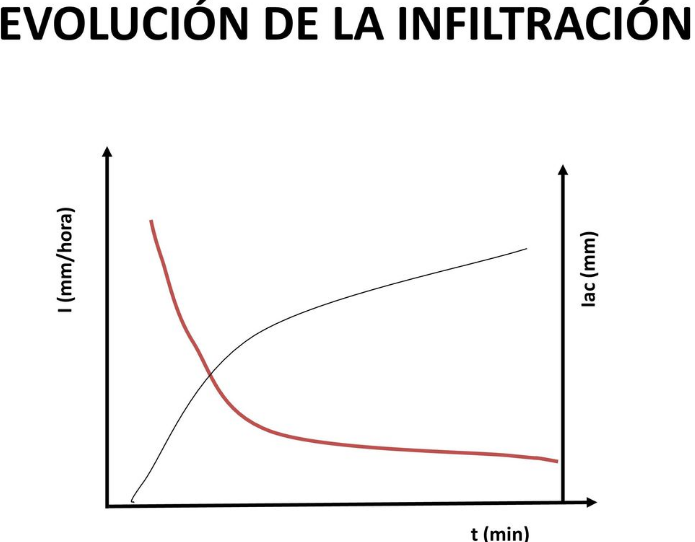
The infiltration capacity of a soil This refers to the flow rate of the water passing through it; it is also known as saturated hydraulic conductivity. It is expressed as the height of water filtered per unit of time (mm/h).
The term infiltration capacity describes the ability of a soil to drain water.
In order to measure the infiltration capacity of a soil we can perform a infiltration test. It is important to take the initial soil moisture reading as the infiltration rate will depend on these preconditions. It is normal for infiltration to be very fast at the beginning of the test if the soil is very dry, and will gradually decrease as the soil moisture increases. Once the capillary pores are filled with water, the gravitational forces will cause a constant downward movement: we will then say that the saturated hydraulic conductivity.
Factors affecting the infiltration capacity of the soil are: timing of irrigation cycles, initial moisture content, hydraulic conductivity and surface conditions.
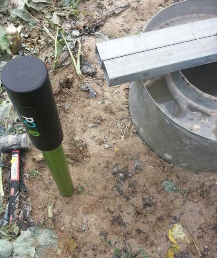
Depending on the soil textures, different infiltration values will be reached, and the curves will be different for heavy soils such as clay or light soils such as sandy soils. On newly constructed greens, values of 150mm/h are recommended (USGA), on stabilised greens, the Sports Council recommends values above 100mm/h and on sports surfaces such as football pitches, above 50mm/h.
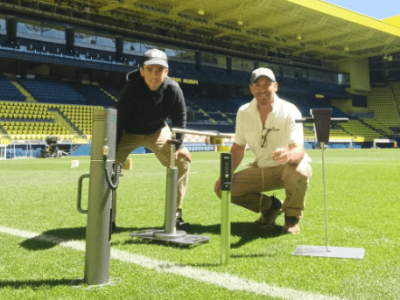
Stainless Steel Double Ring Infiltrometer - Professional Kit
Typical values of saturated hydraulic conductivity according to soil type, source: FAO.
Soil type Infiltration rate (mm/hour)
Sandy less than 30
sandy loam 20-30
free 10-20
clay loam 5-10
clayey 1-5
Below are some results from actual tests:
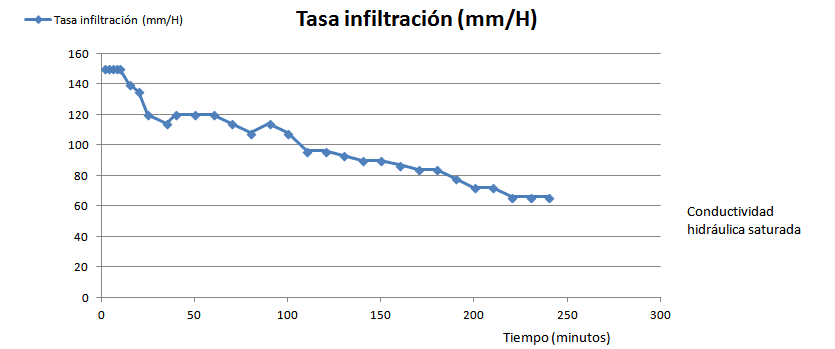
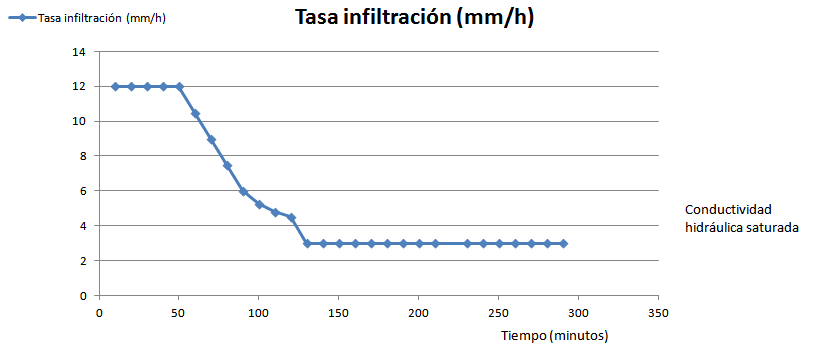
In the same way that the initial soil moisture reading has to be taken, it is interesting to take the final readings at the different depths, in order to know how saturation is reached and at what depths. It is also useful to take the VWC readings during the whole process and check how the value becomes constant when saturation is reached, at the same time as the saturated hydraulic conductivity.

 Español Español
  English (UK)
 Português
 Français
 Italiano
 Deutsch
 العربية





2 responses
Thanking you for the information
Very interesting
There are occasions when technical terminology is not used rigorously, making it difficult to understand.
This does not mean that the information is wrong.
Example:
"The infiltration capacity of a soil refers to the rate of flow of water through the soil and is also known as saturated hydraulic conductivity." they do not realise that it is passing through the soil surface... "passing through the soil"... it is also given in percolation at any level, wherever you want to know it.
Thank you very much for your advice. We will improve in future entries.