

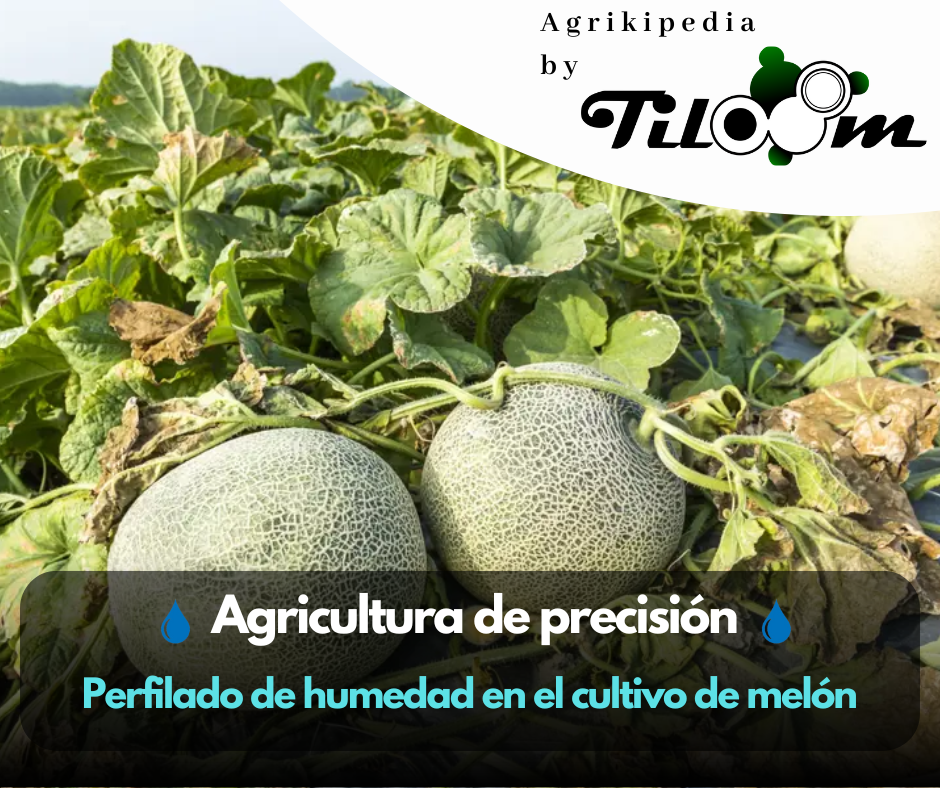
Growing melons outdoors, like any other vegetable, requires precise irrigation management to optimise growth and avoid problems such as leaching or water stress. In this context, Spectrum moisture profiling probes, such as the WaterScout 6068 LoRa Profiler, have become essential tools for growers. These probes allow the monitoring of soil moisture at different depths, helping to determine how much and when to irrigate.
Spectrum WaterScout 6068 LoRa Profiler probes measure soil moisture at multiple depths, allowing detailed analysis of the water profile. In melon cultivation, probes are installed at depths of up to 50 cm to prevent leaching, i.e. the loss of nutrients due to excess water seeping beyond the root zone. On the other hand, surface probes (at 10 cm or 16 cm) are key to determine the timing of irrigation. When the surface moisture falls below the Easily Assimilated Water (AFA) level, the next irrigation cycle is triggered. All these sensors fit into a single profiler.

Below is a graph showing soil moisture at 40 cm depth (SM/T - 40cm/16in - A: Soil Moisture). The graph indicates a peak in moisture around 10:00 a.m., probably after an irrigation, followed by a gradual decrease as the plants consume the available water.

The Spectrum probes are installed in fields prepared with plastic mulch, as shown in the pictures of an outdoor melon crop. The probes are inserted into the soil using a drill, ensuring proper contact with the ground. In the pictures, you can see the installation equipment, which includes an electric drill and the probe itself, strategically placed between the drip irrigation lines.

To ensure that irrigation is uniform across the whole plot, the TDR150a portable moisture sensor from Spectrum Technologies. This device allows quick measurements to be taken at different points in the field, identifying variations in soil moisture. The image shows the TDR150 in action, showing a reading of 4.6% and 16.4% of volumetric water content (VWC) at 25.2°C, demonstrating how the TDR150 can detect differences in irrigation uniformity between different areas of the crop.

The weather station WatchDogalso part of the ecosystem SpecConnectprovides essential data for irrigation management and crop protection. Equipped with a rain gauge, it measures the reference evapotranspiration (ETc) adjusted to the melon crop, which helps to calculate the real water needs. It also includes a pest and disease prediction model, allowing farmers to take preventive measures. The image shows the station WatchDog installed in the field, powered by a solar panel to guarantee its autonomy.

The integration of all these tools into the SpecConnect ecosystem allows farmers to manage irrigation accurately and efficiently. The Spectrum probes provide real-time data on soil moisture, soil moisture, soil moisture, and TDR150 ensures the uniformity of irrigation, and the season WatchDog provides climatic and predictive information. In the final image, field technicians can be seen using these tools to make informed decisions, optimising melon crop management.

The use of Spectrum moisture profiling probes, in conjunction with the TDR150 and the station WatchDogrepresents a significant advance in outdoor melon cultivation. These technologies, integrated into the SpecConnect ecosystem, enable accurate monitoring of irrigation parameters, ensuring efficient water use and protecting crop health. For growers transplanting melons in April, these tools are key to maximising yield and sustainability.
If you would like to learn more about these technologies or seek advice on how to implement them in your crop, do not hesitate to contact our team of experts at Tiloom. Write to agro@tiloom.com and discover how to optimise your farming practices with advanced solutions.
 Español Español
  English (UK)
 Português
 Français
 Italiano
 Deutsch
 العربية


