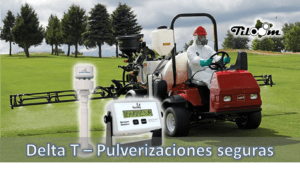


Effective spraying of crop protection products is the most important factor in determining a quality treatment of a specific crop protection product. The main disadvantage encountered when spraying effectively is drift. What is drift and why does it occur?
It is easy to apply in unwanted places and depending on the variables impacting on the target is complicated.
Each plant protection product has different characteristics of volatility, density or vapour tension.
This is the most important point, as it is very important to apply in the right weather conditions. This is where the value comes in. Delta T (ΔT). The Delta T number is the result of all the instantaneous weather variables that determines whether or not it is a good time to apply.
The most advanced sprayers allow for high precision in droplet size, application cone type, distance to target, auto-stabilisation of application rates, air curtain assistance or speed of the tractor applicator.
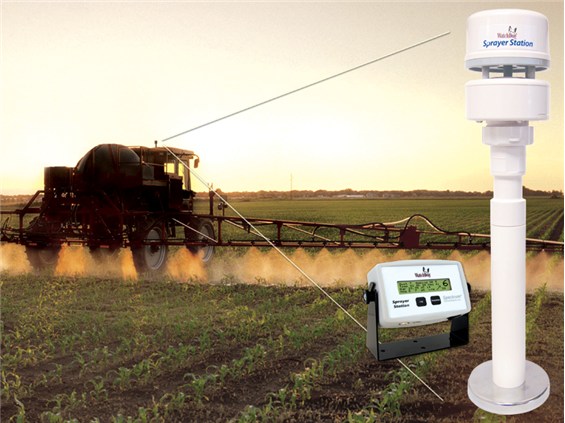
WatchDog has a weather station designed for safe spraying. By means of a small ultrasonic station on the tractor and a display inside the tractor, we know in real time whether it is the right time to apply by means of the Delta T calculation.
For all of the above reasons, it is essential that the applicator knows the key weather conditions for the application at all times:
Tractor sprayer weather stations are powerful tools that accurately and instantly calculate the Delta T value. This indicator is closely linked to the ability of the atmosphere to evaporate the water from the spray droplet and the ability of the plant leaf tissue to absorb the product.
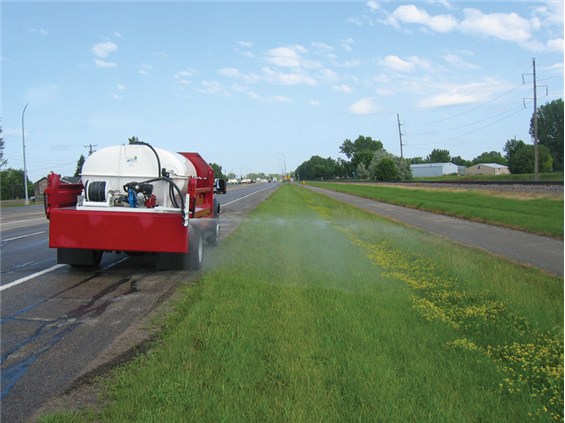
The use of the Delta T parameter is very intuitive. Values below 2 indicate environments that allow the product to remain in the form of a misty droplet in the atmosphere for too long, thus increasing the risk of drift. If the value is close to 0 there may even be dew. Values between 2 and 8 are appropriate. For products with a higher risk of evaporation it is advisable to work with the lowest values.
However, Delta T values higher than 8 are no longer recommended for work as there is a high risk of evaporation, so few drops will reach the target, wetting less and causing a lot of drift.

Everything explained above is based on psychometry. The study of air in all different conditions. It is not enough to know the relative humidity or the temperature.
There are adjuvants such as wetting agents that modify the characteristics of the liquid, allowing spray application under more unfavourable conditions. Wetting agents reduce water evaporation and prolong the half-life of the droplets in an adverse environment. In the most extreme cases, the application can be increased with a Delta T of 10.
If you want to know more about the half-life of gout and the usefulness of the Delta T Index please contact us at info@tiloom.com.
 Español Español
  English (UK)
 Português
 Français
 Italiano
 Deutsch
 العربية