

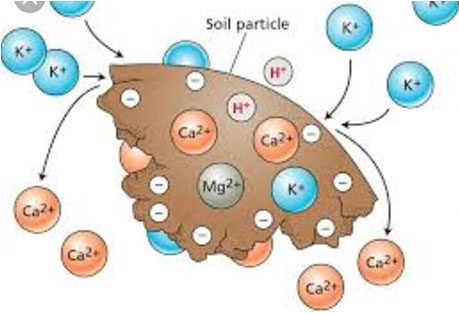
The cation exchange capacity of soils (C.E.C.) is the ability of soils to retain cations through their negative charges, whether from clay particles, metal oxides and/or organic matter.
The greens, built to USGA specifications, have almost none of the above mentioned elements, which is why the C.I.C. values of the greens are generally quite low.
The C.I.C. is expressed as milliequivalents per 100 grams of soil and can be determined in the laboratory, or even estimated through the organic matter or clay content. For example, the following empirical formulae relate the C.I.C. to the % of clay and organic carbon at neutral pH.
C.I C (meq/Kg) = 7*(% clay) + 35*(% C) Source: Breeuwsma et al., 1986.
C.I C (mmol/Kg) = -311+268*pH Source: Heling et al.,1964.
https://www.tiloom.com/producto/phimetro-fieldscout-soilstick-ph/
The pH buffering capacity of different soils ("buffering power") depends to a large extent on this parameter. The exchange positions of a clay-acid soil can be multiplied by a factor of 30 compared to a sandy soil, and thus the alkalinity required to vary the same pH unit. Hence, in greens the pH variability fluctuates a lot and in a clay or calcareous soil it is much more constant.. Studies on the influence of pH on greens due to the nature of the water in the greens. irrigation and to the various nitrogen fertilisers have been extensively studied. Obear R.G., et al 2015.
Cation exchange capacity ranges vary according to the textures of different soils.

The composition of the soil nutrient pool can be varied by the exchange of nutrients with each other (depends on the cation exchange capacity of the particular soil).
The adsorption power of the different cations with the soil matrix differs between them in the following order of increasing preference:
Al > H > Ca > Mg > NH4 > K > Na
To estimate the reactions and relationships that occur between intrinsic soil anions and cations and nutrients, Tiloom recommends a preliminary study of the irrigation water and measurement of the cation exchange capacity (C.E.C.).
 Español Español
  English (UK)
 Português
 Français
 Italiano
 Deutsch
 العربية



One Response
Good afternoon, I would like to know the source from which you obtained the table of the range of CIC values according to soil type. I need to reference it for a university work and it would be very useful to me, as I have looked for it and have not found a similar one. Thank you very much.