
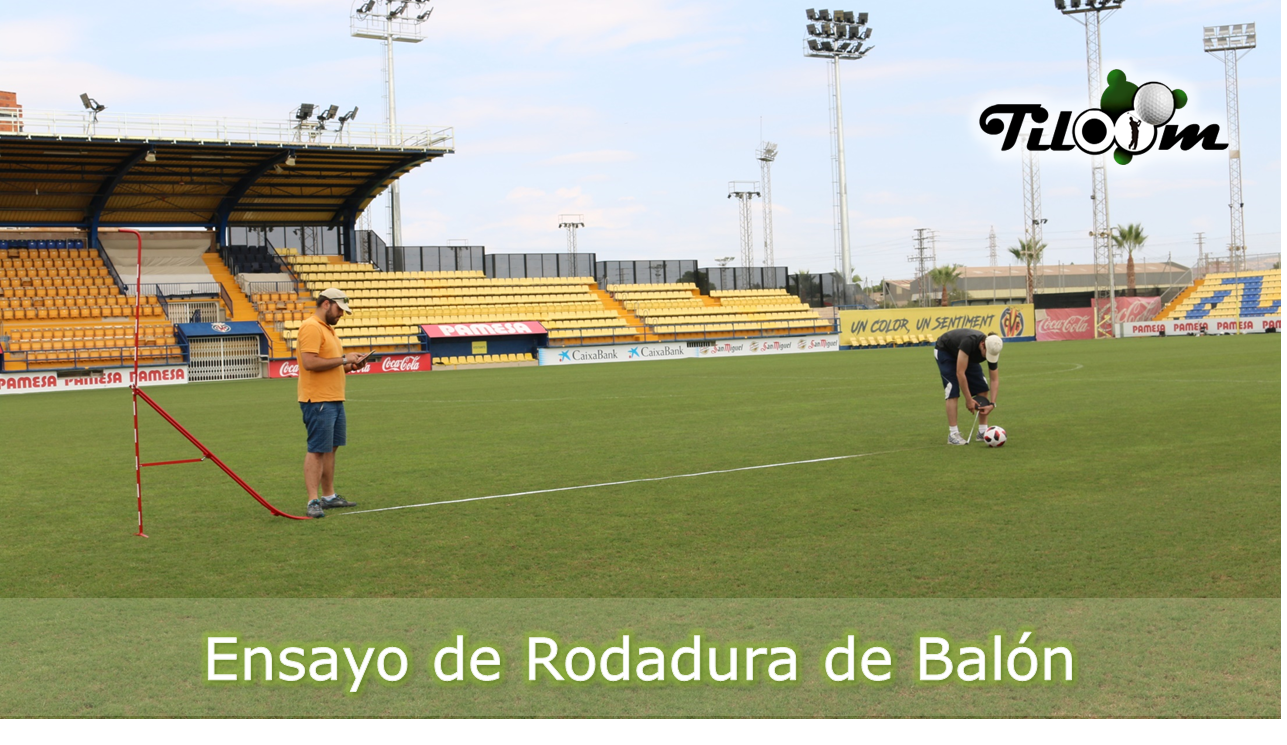
In the football the ball rolling on the turf determines the agility of the match. According to the Standard UNE-EN 12234 on determining the behaviour of the ball rollingThe distance to be covered must be an adequate and undeviating distance of between 5 and 12 metres.
In the following video we show you how to perform the test in detail:

The tool used for this test is a standardised ramp. The ramp is installed at 45° to ground level, the ball is placed at the top and dropped down the ramp to roll down the field until it comes to a natural stop.
At each point of the test it is important to perform the test several times, directing the ramp in 4 directions (towards the two goals and towards the two risers) pointing the metre distance and the centimetre deviation to each side.
Even with a construction of the camp excellent surface deformation is unavoidable, either by the passing of maintenance machinery or by the activity of the players.
On the other hand, the length travelled is dependent on the humidity of the lawn. The Sports Turf Research Institute (STRI) indicates that the higher the moisture, the shorter the ball travels. The same applies to the height of the grass: very short mown lawns allow the ball to travel more metres than if it were cut longer.
Finally, the wear and tear of the turf itself is a key factor in determining the length of the ball's path, as busier areas such as the centre of the pitch or the penalty area allow for longer path lengths than less frequented areas such as corners.
The instrument for this entry can be purchased from the following link:
Make better decisions with us, our top quality services and our more than 15 years of experience in Football and Golf are our guarantee:
 Español Español
  English (UK)
 Português
 Français
 Italiano
 Deutsch
 العربية