
Plant genetics in grass seeds is a job that the industry is constantly doing year after year. The group of grasses is very large and really important for mankind, so we have to admire the work of the industry to bring better individuals to the market year after year.
Grasses are usually also grasses, and in this part of the industry, too, strong efforts are made to improve the needs of the fields year after year. Smaller varieties, more drought tolerant, more resistant to trampling, or lower mowing are sought after. All these market requests are met by the industry with very intensive breeding and companies like ICL with ProSelect meet the needs of professionals.
Before discussing selection methods, it is necessary to make a few points clear:
Within traditional plant breeding (the most widely used today) there are several very different methods, and within these methods there can be important differences between breeders. Today we will explain some of them:
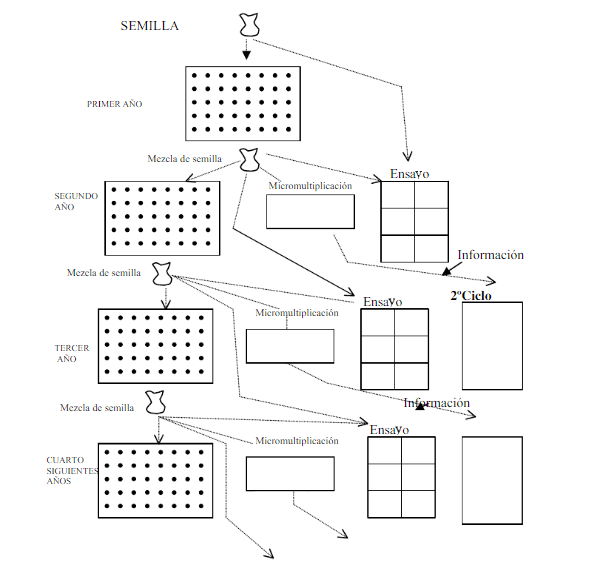
This is the simplest method of all, it involves choosing from a population of 0 seeds to the best specimens. It uses open pollination for its results. This selection is done by their physical characteristics, also known as phenotype. Then collect the seed from the best individuals and mix it. This new population would already be improved. This activity is carried out until a uniform population with the desired characteristics is achieved.
This selection is effective for easily observable selection traits, such as resistance to drought or low mowing.
As these plants cross each other randomly, we cannot select the male gamete by this method. In order to be able to estimate their behaviour, the following are carried out progeny testing in which the male gamete can be monitored and its impact known.
On other occasions it is desired to force heterosis. Heterosis is the superiority of individuals descended from two very different parents. This is also known as hybrid vigour.
For this purpose, controlled crosses are made between individuals which are two Pure Lines distinct. The pure lines are the individuals descended from the same and which attain the homozygosis. This crossbreeding between different pure lines produces a strong improvement in the character of the plants, enhancing their virtues.
Synthetic varieties are obtained by making a controlled mixture of individuals with desirable characteristics.
A large number of different individuals (pure lines, hybrids, clones...) can come into play, making their offspring (seeds) very variable and must be tested to ensure that they are completely random crosses.
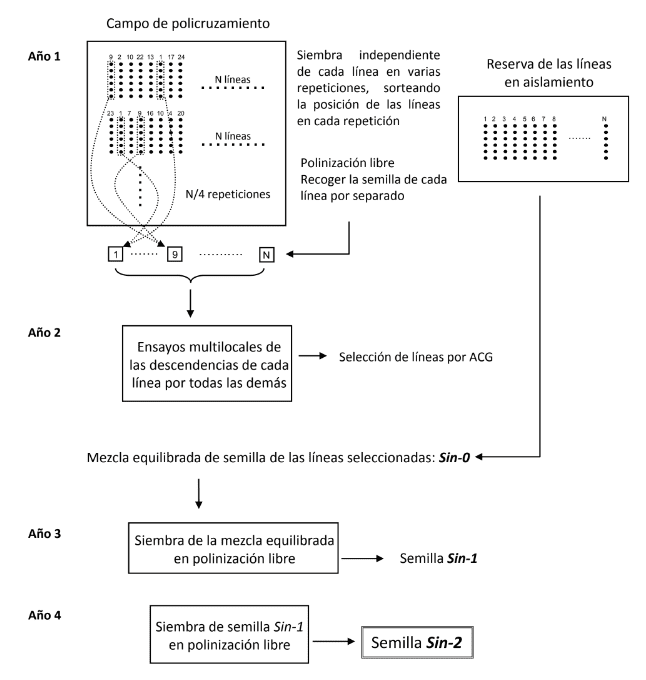
The main advantage is that synthetic varieties try to exploit hybrid vigour more effectively than mass-bred populations.
Here is a very interesting video of how they sterilise wheat inflorescences to conserve species.

A common misconception among growers is that the descendant seed is the same as the parent. This is a big mistake, as cross-pollinated species produce seeds with very different genetics when they mix with each other.
Plant breeding is a highly technical and complex branch of crop production. The professionals dedicated to it do an excellent job and, as it happens in any other industry and especially in agriculture, when a job is well done, no one falls on it, nor gives it the importance it deserves.
The intention of this entry is to shed light on how new seeds are selected for the industry and the need for access to them in order to maintain crop quality and profitability. There are more methods for genetic selection.
 Español Español
  English (UK)
 Português
 Français
 Italiano
 Deutsch
 العربية