The conductivity Electrical conductivity (EC) is the sum of the conductivities of the different types of ions present.
It is a physical parameter that measures, at a given temperature, the ability of a substance to conduct electric current.
Its value is determined by the presence of ions and their mobility in solution.
In agronomy, the EC is one of the most commonly used parameters to measure the salinity of the saturated extract (ECe) or water (ECw), as its value is proportional to the amount of salts in solution contained in it. (Rhoades, 1981). Its value is measured in deciSiemens / metre (dS/m) or millimhos / centimetre (mmho/cm) where1 dS/m = 1 mmho/cm.
The main objective of EC analysis in soils is to determine whether soluble salts are present in sufficient quantities to affect seed germination, plant growth, or the water absorption of them.
The ECe is influenced by the different physical and chemical properties of the soil.
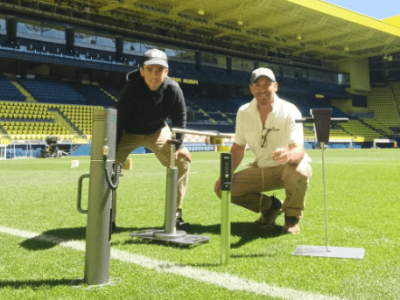
FieldScout Direct Soil EC Meter
For this reason conductivity will increase to the extent that the soil contains:
- Higher moisture content. Soils with higher porosity or lower bulk density will have higher water storage capacity and can reach higher values of electrical conductivity (Samouëlian et al 2005).
- Higher content of dissolved salts. Increased salinity and cation exchange capacity (Rhoades and Corwin, 1981).
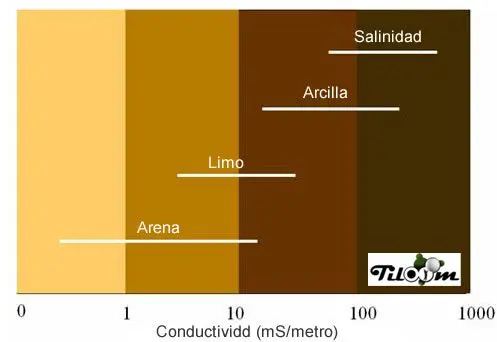
- Fine texture. Because of their higher water storage capacity and higher cation exchange capacity, clays have higher conductivity values.
| Soil classification according to crop tolerance to salts (Adapted from Van Hoorn and Van Alphen, 1994). |
| |
| Categories |
Average CEe
(dS/m) |
Features |
| |
| Non-saline |
<2 |
No crops are affected |
| Slightly saline |
2 - 4 |
Only sensitive crops affected |
| Saline |
4 - 8 |
Large number of crops affected |
| Strongly saline |
8 - 16 |
Use of tolerant crops |
| Extremely saline |
>16 |
Only a small number of crops are possible |
| |
In water, the EC is measured for the purpose of determining the WATER QUALITY from irrigation and the washing requirements of a soil irrigated with saline water.
| Risk of salinisation of a soil according to the electrical conductivity (dS/m) or the salt concentration water use for irrigation according to the Ministry of Agriculture. |
| |
| Risk |
CEw
(dS/m) |
TDS
(ppm or mg/l)
|
| |
| No risk |
<0,7 |
<448 |
| Slight to moderate risk |
0,7- 3 |
448-1920 |
| Severe risk |
˃3 |
˃ 1920 |
| |
The EC does not differentiate what type of salts are in the sample but allows us to determine the total amount of dissolved salts (TDS), defined as the total ion concentration in solution expressed in mg/l or ppm, where:
TDS (mg/l) = EC (dS/m) x 640 if EC ˂ 5 dS/m
TDS (mg/l) = EC (dS/m) x 780 if EC ˃ 5 dS/m
(Source: Robert N. Carrow and Ronny R. Duncan)


 Español
  English (UK)
 Português
 Français
 Italiano
 Deutsch
 العربية
2 responses
very good afternoon, could you help me in case of conductivity in sodic soils, please.
Of course you can. Leave your question here or write to soporte@tiloom.com