

Growth potential (GP) is a ratio or measure that serves as a tool to relate the growth of turfgrass on greens, fairways or tees to the temperatures of the different areas under study. It was developed by PACE Turf (W. Gelernter and L. Stowell) and uses average monthly temperatures (t) and optimum growing temperatures (to), either warm weather (30.5°C/87.5°F) or cool weather (19.5°C/67.5°F) to relate to desired growth.
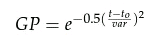
In the experiment to obtain the value of the growth potential, var is a constant of value 10 for species C3 and value 12 for species C4.
The value of the growth potential ranges from 0 (no growth) to 1 (maximum growth).
If we carry out maintenance that manages to balance the growth factors such as water and sunlight, providing them in an optimal way, we can estimate the growth potential according to the study of temperatures.
Another interesting result of the above analysis is the overlapping of GrowthPotential, GP, plots of cold and warm climate species for the same location. The overlap of the graphs will result in the ideal dates for the sowing of each species. See attached graph.
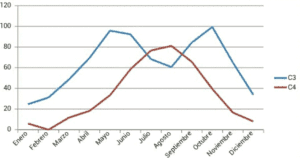
The interpretation of this graph (calculated for a Mediterranean area) shows that cold climate or C3 species (Agrostis, Poa Anua or Rye Grass) have a higher growth potential for spring and autumn temperatures. However, C4 grasses (Cynodon Dactilon or Paspalum) have a maximum yield in summer.
The "high peaks" in both graphs show us the highest yielding periods for each species, and some greenkeepers tend to make them coincide with the aeration The aim is to achieve a more rapid recovery of the plant at these times due to its greater capacity to grow and regenerate.
Another conclusion can be drawn from the graph: by observing the crossing of both lines we can determine the ideal moment to reseed species such as Rye Grass C3 in a field with a larger surface area of Cynodon Dactilon C4 (warm climate species) if the golf course is in the peninsular Mediterranean area, finding a common growth potential of 80% where the new cold climate species will start to compensate the slowing down of the C4 cespitose sown as a base.
 Español Español
  English (UK)
 Português
 Français
 Italiano
 Deutsch
 العربية